
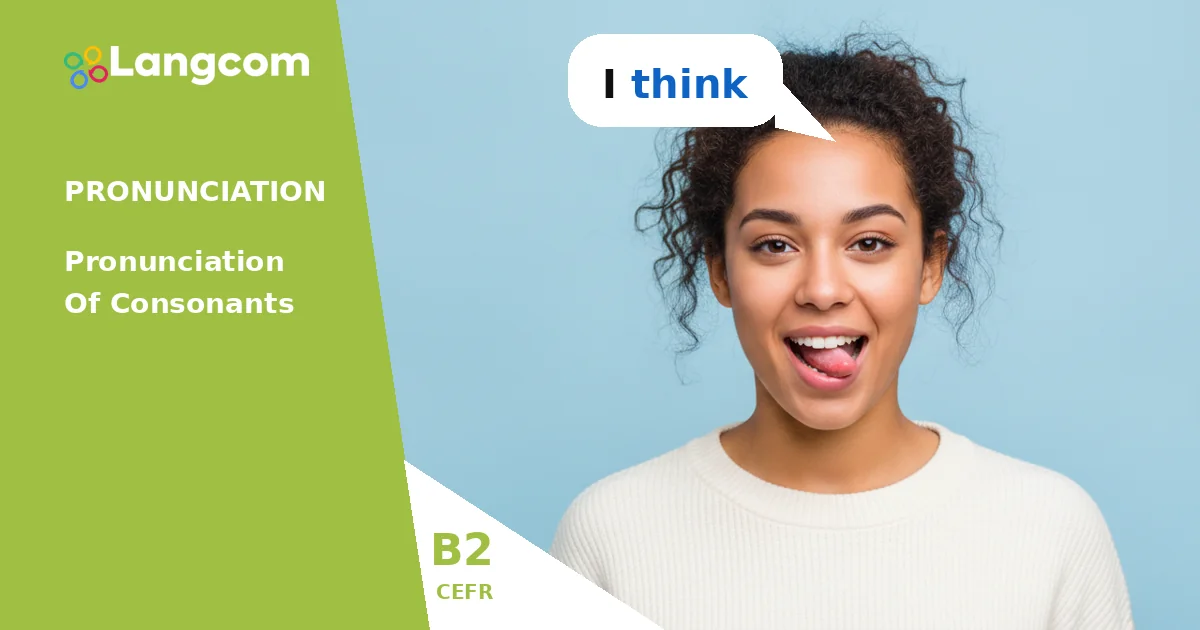

What Are the Two ‘Th’ Sounds in English?
The letter combination th in English is unique because it represents two different sounds. These sounds are known as ‘fricatives’ because air is forced through a narrow opening in your mouth.
- Voiceless /θ/: This sound is produced without any vibration in your vocal cords. It is like a soft ‘s’ or ‘f’ sound, but with your tongue in a different position.
- Voiced /ð/: For this sound, your vocal cords vibrate, creating a buzzing feeling in your throat. It is similar to a ‘z’ or ‘v’ sound, but again, with your tongue between your teeth.
✍️ Not sure which level you are?
Take our free placement test and get personalized feedback from certified Cambridge examiners.
Faça nosso teste de nivelamento GRATUITOHow Do You Make the ‘Th’ Sounds?
The tongue position is the same for both th sounds. The key difference is whether your vocal cords vibrate.
- Tongue Position: Gently place the tip of your tongue between your upper and lower front teeth. It should stick out slightly.
- Airflow: Push air out of your mouth over your tongue. Do not block the air completely.
- Voiceless /θ/: Keep your vocal cords relaxed. You should only hear the air escaping, like a gentle hiss. Try saying think ou three.
- Voiced /ð/: Vibrate your vocal cords as you push the air out. You should feel a buzzing sensation in your throat and on your tongue. Try saying this ou that.
When Do We Use Voiceless /θ/ vs. Voiced /ð/?
While there are no absolute rules, some patterns can help you predict which th sound to use.
- Voiceless /θ/ is common:
- At the beginning of most content words (nouns, verbs, adjectives): thank, theory, thin.
- At the end of many words: bath, mouth, truth.
- In the middle of some words: athlete, sympathy.
- Voiced /ð/ is common:
- At the beginning of most function words (articles, pronouns, conjunctions): the, this, they.
- In the middle of many words: mother, weather, bother.
- At the end of some verbs: breathe, bathe.
Remember that these are general guidelines, and exceptions exist. Listening carefully to native speakers is always the best way to learn.
Minimal Pairs: Hear the Difference
Minimal pairs are words that differ by only one sound. Practicing these pairs can help you distinguish between /θ/ e /ð/.
- bath (/bæθ/) vs. bathe (/beɪð/)
- ether (/ˈiːθər/) vs. either (/ˈaɪðər/ ou /ˈiːðər/)
- thin (/θɪn/) vs. then (/ðɛn/)
- worth (/wɜːrθ/) vs. worthy (/ˈwɜːrði/)
Exemplos
- I think this thing is the best.
- My mother and father are thirty-three.
- Can you breathe through your mouth?
- She has a healthy tooth.
- I thought they would come together.
Prática
Ready to earn your certificate?
Langcom prepares students for Cambridge, IELTS, TOEFL, DELE, SIELE and Michigan exams.
Get started with LangcomErros comuns entre falantes de espanhol
Many Spanish speakers, and learners from other language backgrounds, find the th sounds challenging. A common mistake is substituting them with sounds that exist in their native language.
- Substituting /t/ ou /d/:
- Errado: I tink so. (for I think so.)
- Errado: Where is de book? (for Where is the book?)
- Direita: I think so.
- Direita: Where is the book?
- Substituting /s/ ou /z/:
- Errado: I need a bas. (for I need a bath.)
- Errado: Is zis your car? (for Is this your car?)
- Direita: I need a bath.
- Direita: Is this your car?
Remember to place your tongue between your teeth for the correct th sound, rather than behind them.
Perguntas frequentes
Is ‘th’ always pronounced the same way?
No, the letter combination th has two distinct pronunciations: the voiceless /θ/ (as in three) and the voiced /ð/ (as in the).
How can I practice the ‘th’ sound effectively?
Practice in front of a mirror to check your tongue position. Listen carefully to native speakers and try to imitate them. Repeat minimal pairs like bath e bathe.
Why is correct ‘th’ pronunciation important for B2 learners?
Correct pronunciation improves clarity and helps avoid misunderstandings. It also makes your English sound more natural and confident, which is important at a B2 level.
Are there any words where ‘th’ is silent?
Generally, no. The th is almost always pronounced as either /θ/ ou /ð/. Very few exceptions exist, like in some specific names or medical terms, but these are rare.
Does ‘th’ pronunciation appear in English exams?
Yes, clear pronunciation of sounds like th is assessed in the speaking sections of exams like Cambridge B2 First or IELTS. Mispronunciations can affect your fluency and clarity scores.



0 Comentários