
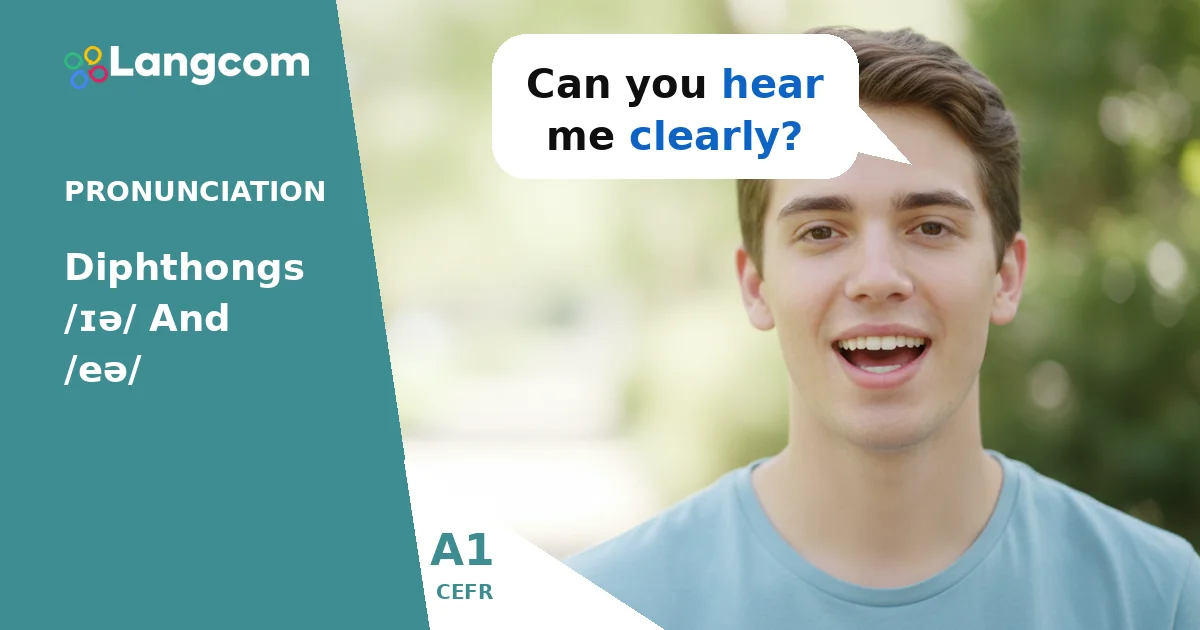

Diphthongs are special vowel sounds that combine two vowel sounds into one smooth sound. For A1 learners, understanding the English diphthongs /ɪə/ (as in here) and /eə/ (as in bear) is important for clear pronunciation. These sounds are not single vowels but a glide from one vowel sound to another within the same syllable. For /ɪə/, your mouth starts with an /ɪ/ sound and moves to /ə/. For /eə/, it starts with /e/ and moves to /ə/. Mastering these will help you speak and understand English better.
What is a Diphthong Sound?
A diphthong is a vowel sound that changes. It starts with one vowel sound and then moves to another vowel sound in the same syllable.
- Think of it as two sounds working together.
- English has many diphthongs. Today, we focus on two important ones for A1 learners: /ɪə/ e /eə/.
🎓 Aprenda inglês com o método misto
Grupos pequenos · Tutor de IA 24 horas por dia, 7 dias por semana · Preparação para os exames de Cambridge
Planos de $39 $79 por mês
How Do You Make the /ɪə/ Sound?
O /ɪə/ sound is like saying ‘ih’ then ‘uh’ very quickly together.
- Start with the short /ɪ/ sound, like in sit.
- Then, move your mouth to the /ə/ (schwa) sound, like in about.
- Your mouth moves slightly as you make the sound.
Common spellings for /ɪə/ include:
- ear: hear, fear, clear
- ere: here, mere
- eer: beer, deer
- ea: idea (at the end)
How Do You Make the /eə/ Sound?
O /eə/ sound is like saying ‘eh’ then ‘uh’ very quickly together.
- Start with the /e/ sound, like in bed.
- Then, move your mouth to the /ə/ (schwa) sound, like in about.
- Again, your mouth moves smoothly from the first sound to the second.
Common spellings for /eə/ include:
- air: hair, chair, fair
- are: care, share, rare
- ear: bear, pear, wear
- ere: there, where
Comparing /ɪə/ and /eə/ Sounds
The main difference between /ɪə/ e /eə/ is the first sound you make.
- For /ɪə/, you start with a higher, shorter ‘ih’ sound.
- For /eə/, you start with a more open ‘eh’ sound.
- Both sounds end with the same relaxed /ə/ sound.
| Sound | Common Spellings | Example Words |
|---|---|---|
| /ɪə/ | ear, ere, eer, ea | hear, here, beer, idea, clear, fear, mere, deer |
| /eə/ | air, are, ear, ere | hair, care, bear, there, chair, share, pear, where |
Examples
- Can you hear me clearly?
- I live near here.
- There is a chair over there.
- Be careful with that pear.
- I have an idea for a career.
- The air is fresh here.
Practice
💬 Precisa de orientação personalizada?
Como Centro Autorizado de Preparação para os Exames de Cambridge, podemos orientá-lo na escolha do curso e da certificação mais adequados. Entre em contato com nossos orientadores hoje mesmo.
Converse com um consultor pelo WhatsAppCommon mistakes for Spanish speakers
Spanish speakers often make these mistakes:
- Pronouncing as a single vowel: Sometimes, learners pronounce here as /hi:/ (like ‘hee’) instead of /hɪə/. Remember the two sounds.
- Confusing similar words: Words like bear (/eə/) and beer (/ɪə/) sound very different in English. Pay attention to the starting vowel sound.
- Not moving the mouth: The mouth must move slightly to create the glide of a diphthong. Do not keep your mouth still.
Perguntas frequentes
What is the difference between a monophthong and a diphthong?
A monophthong is a single, pure vowel sound, like /i:/ em sheep. A diphthong is a combination of two vowel sounds that glide from one to the other within the same syllable, like /ɪə/ em here.
How can I practice these diphthong sounds?
Listen to native speakers carefully. Repeat words like here e hair many times. Record your voice and compare it to a native speaker. Focus on the movement of your mouth.
Are there other diphthongs in English?
Yes, English has several other diphthongs, such as /aɪ/ (as in my), /oʊ/ (as in go), and /aʊ/ (as in now). For A1, focusing on /ɪə/ e /eə/ is a great start.



0 Comentários