

What are Verbs of Effort?
Verbs of effort describe actions related to trying, managing, and succeeding in tasks or difficult situations. They help us explain how we approach challenges and what the outcome is.
These verbs are important for B2 learners because they add detail and nuance to your descriptions of work, studies, and personal experiences.
✍️ Not sure which level you are?
Take our free placement test and get personalized feedback from certified Cambridge examiners.
Faça nosso teste de nivelamento GRATUITOKey Verbs of Effort and Their Meanings
Let’s explore some common verbs of effort. Pay attention to their specific meanings and how they are used in sentences.
- Go ahead with: This means to start doing something, especially after planning or permission. It suggests moving forward with a decision.
Exemplo: The company decided to go ahead with the new marketing campaign. - Cope with: To manage to live with something quite well, even if it is difficult. It implies handling a situation successfully.
Exemplo: She found it hard to cope with the stress of her new job. - Overcome: To succeed in controlling or dealing with a difficult problem or feeling. It means to conquer something.
Exemplo: He had to overcome his fear of public speaking. - Work on: To spend time doing something to improve it or to complete it. This verb suggests ongoing effort.
Exemplo: I’m working on my English pronunciation every day. - Get on with: To continue doing something and not worry about the past or things that are delaying you. It means to proceed.
Exemplo: After the argument, they decided to get on with their lives. - Tackle: To try to do a difficult task or deal with a problem. It suggests a direct and determined approach.
Exemplo: The government is trying to tackle the problem of unemployment. - Give up: To stop doing something, especially something you have been trying hard to do. It means to quit.
Exemplo: Don’t give up on your dreams!
How to Use These Verbs in Context?
These verbs are often used when describing personal achievements, professional challenges, or daily struggles. They help you express resilience and determination.
- When you start a new project, you might go ahead with it.
- If you face a difficult situation, you need to cope with it.
- To defeat a problem, you must overcome it.
- When you are developing a skill, you work on it.
- After a setback, it’s important to get on with your plans.
- If a task is challenging, you need to tackle it.
- If something is too difficult, you might decide to give up.
| Verb/Phrase | Meaning |
|---|---|
| Go ahead with | Start doing something |
| Cope with | Manage to live with something difficult |
| Overcome | Succeed in controlling a difficult situation |
| Work on | Spend time doing something to improve it |
| Get on with | Continue doing something and not worry about the past |
| Tackle | Try to do a difficult task or deal with a problem |
| Give up | Stop doing something |
Exemplos
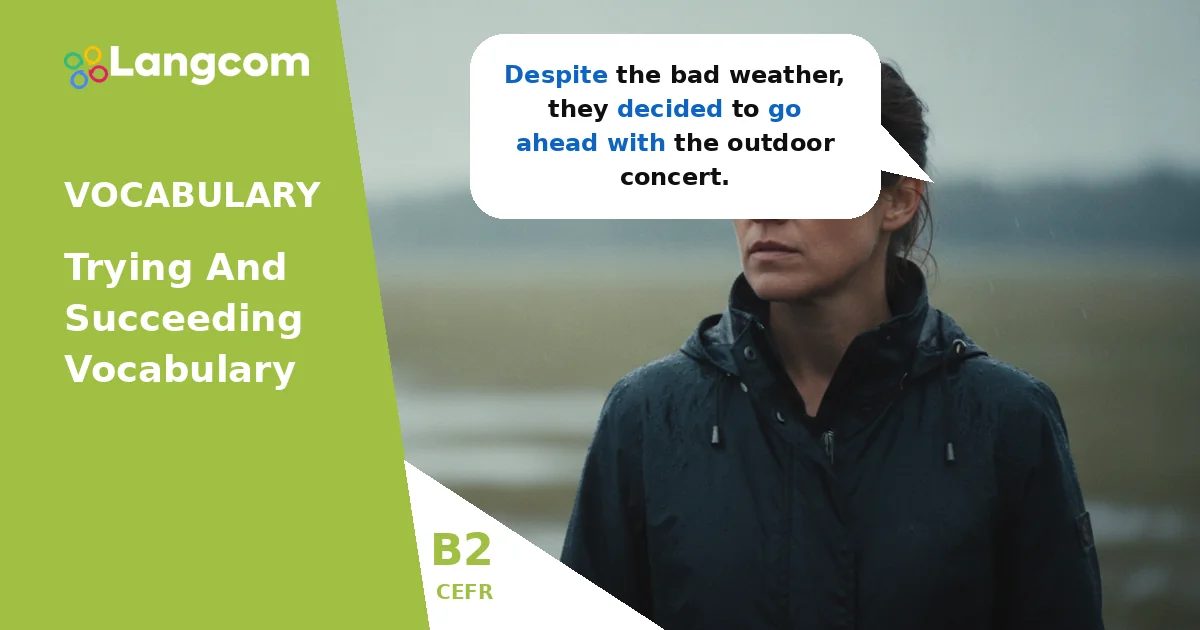
- Despite the bad weather, they decided to go ahead with the outdoor concert.
- It took her a long time to cope with the loss of her pet.
- Many athletes have to overcome injuries during their careers.
- He’s been working on his novel for over five years.
- Let’s just get on with the meeting, we’re running out of time.
- She decided to tackle the most difficult questions first.
- Never give up on learning English; practice makes perfect!
Prática
Ready to earn your certificate?
Langcom prepares students for Cambridge, IELTS, TOEFL, DELE, SIELE and Michigan exams.
Get started with LangcomErros comuns entre falantes de espanhol
Spanish speakers sometimes make mistakes with these verbs due to direct translation or confusion with similar-sounding words.
- Confuso overcome with ‘superar’ in all contexts: While ‘superar’ often translates to overcome, remember that overcome specifically means to succeed in controlling or dealing with a difficulty. For example, you overcome a fear, not usually a simple obstacle like a wall.
- Misusing phrasal verbs: Phrasal verbs like go ahead with, cope with, work on, e get on with have specific prepositions. Do not omit them or use the wrong one. For instance, it’s cope with, not just cope when referring to a situation.
- Using give up too broadly: Give up means to stop trying. It’s not always the same as ‘abandonar’ if ‘abandonar’ means simply leaving a place or object. Use give up when someone stops an effort or a habit.
Perguntas frequentes
Why are these verbs important for B2 English learners?
For B2 learners, these verbs add precision and sophistication to your language. They help you express complex ideas about challenges, persistence, and success, which are common topics in B2-level conversations and writing. Mastering them shows a deeper understanding of English vocabulary beyond basic terms.
Can I use these verbs in formal and informal situations?
Yes, most of these verbs are versatile and can be used in both formal and informal contexts. For example, you can tackle a problem at work (formal) or tackle a messy room (informal). Get on with is slightly more informal, while overcome is suitable for any setting.
Are there other verbs similar to ‘verbs of effort’?
Yes, English has many verbs related to effort. Some similar verbs might include strive (to try very hard), endeavor (a formal way to say try), persevere (to continue trying despite difficulties), or manage (to succeed in doing something, especially something difficult).


0 Comentários