
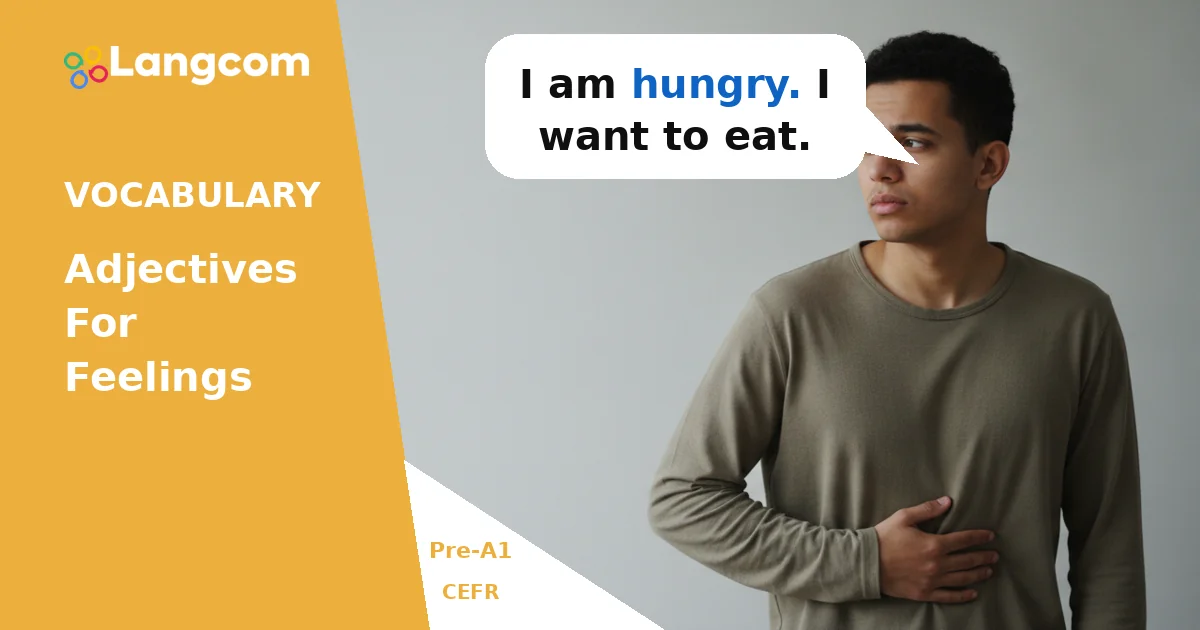

What Are Feeling Adjectives?
Feeling adjectives are words that describe how a person feels. They tell us about emotions or physical states. These words help you share information about yourself with others.
In English, we use many adjectives to talk about feelings. Today, we will learn some very common ones:
- hungry
- thirsty
- hot
- cold
- happy
- sad
- bored
- tired
🎓 Learn English with the Blended method
Small groups · 24/7 AI Tutor · Cambridge preparation
Plans from $39 $79 per month
How to Use Feeling Adjectives
It is easy to use feeling adjectives in English. You just need the verb to be (am, is, are) and the adjective.
For yourself, you say I am + adjective.
- If you need food, say: I am hungry.
- If you need water, say: I am thirsty.
- If you feel warm, say: I am hot.
- If you feel cool, say: I am cold.
- If you feel good, say: I am happy.
- If you feel not good, say: I am sad.
- If you have nothing to do, say: I am bored.
- If you want to sleep, say: I am tired.
Talking About Others’ Feelings
You can also use these adjectives to talk about how other people feel. Just change the form of the verb to be.
- For a man or boy, use He is: He is happy.
- For a woman or girl, use She is: She is tired.
- For more than one person, use They are: They are hungry.
| Adjective | What it means |
|---|---|
| hungry | You want food. |
| thirsty | You want water. |
| hot | You feel warm. |
| cold | You feel not warm. |
| happy | You feel good. |
| sad | You feel not good. |
| bored | You have nothing to do. |
| tired | You want to sleep. |
Examples
- I am hungry. I want to eat.
- She is thirsty. She needs water.
- He is hot. He wants to open the window.
- We are cold. We need our jackets.
- They are happy. They like the music.
- The boy is sad. He lost his toy.
- I am bored. I want to play a game.
- You are tired. Go to sleep!
Practice
💬 Need personalized guidance?
As an Authorized Cambridge Preparation Centre, we can guide you to the right course and certification. Chat with our advisors today.
Chat with an Advisor on WhatsAppCommon mistakes for Spanish speakers
Many Spanish speakers use the verb “tener” (to have) for some feelings. But in English, we use the verb to be (am, is, are) for all these feeling adjectives.
- Incorrect: I have hungry.
- Correct: I am hungry.
- Incorrect: She has cold.
- Correct: She is cold.
- Incorrect: He has tired.
- Correct: He is tired.
Always remember to use I am, He is, She is, We are, or They are with feeling adjectives.
Frequently asked questions
What is an adjective?
An adjective is a word that describes a noun. For example, in I am happy, happy describes I.
How do I say ‘I have thirst’ in English?
In English, you say I am thirsty. We use to be, not to have, for this feeling.
Can I use these adjectives for animals or things?
You can use hungry or thirsty for animals. For things, it is usually not correct. For example, a dog can be hungry, but a table cannot be sad.



0 Comments