

What Are Countable Nouns?
Countable nouns are things we can count. We can use numbers with them.
They have a singular form (one thing) and a plural form (more than one thing).
- We use a or an before a singular countable noun.
- We can add -s or -es to make them plural.
- We can use words like many or a few with them.
🎓 Learn English with the Blended method
Small groups · 24/7 AI Tutor · Cambridge preparation
Plans from $39 $79 per month
What Are Uncountable Nouns?
Uncountable nouns are things we cannot count individually. They are often liquids, materials, abstract ideas, or general food items.
They usually have only one form (singular) and do not have a plural form.
- We do NOT use a or an before an uncountable noun.
- We do NOT add -s or -es to make them plural.
- We use words like much or a little with them.
How Do We Use 'Some' and 'Any'?
Some and any are useful words to talk about quantities when you don't know the exact number.
- We use some in positive sentences. Example: I have some friends.
- We also use some for offers and requests. Example: Would you like some coffee?
- We use any in negative sentences. Example: I don't have any money.
- We use any in most questions. Example: Do you have any questions?
How Do We Use 'Much' and 'Many'?
Much and many help us ask or talk about large quantities.
- Use many with countable nouns. Example: How many books do you have?
- Use much with uncountable nouns. Example: How much water do you drink?
- For positive sentences, a lot of is common for both countable and uncountable nouns. Example: I have a lot of friends. / I have a lot of work.
| Feature | Countable Nouns | Uncountable Nouns |
|---|---|---|
| Can you count them? | Yes | No |
| Singular/Plural? | Both (e.g., book, books) | Only singular (e.g., water) |
| Use 'a' / 'an'? | Yes (e.g., an egg) | No |
| Use numbers? | Yes (e.g., two chairs) | No |
| Quantifiers | many, a few, some, any, a lot of | much, a little, some, any, a lot of |
Examples
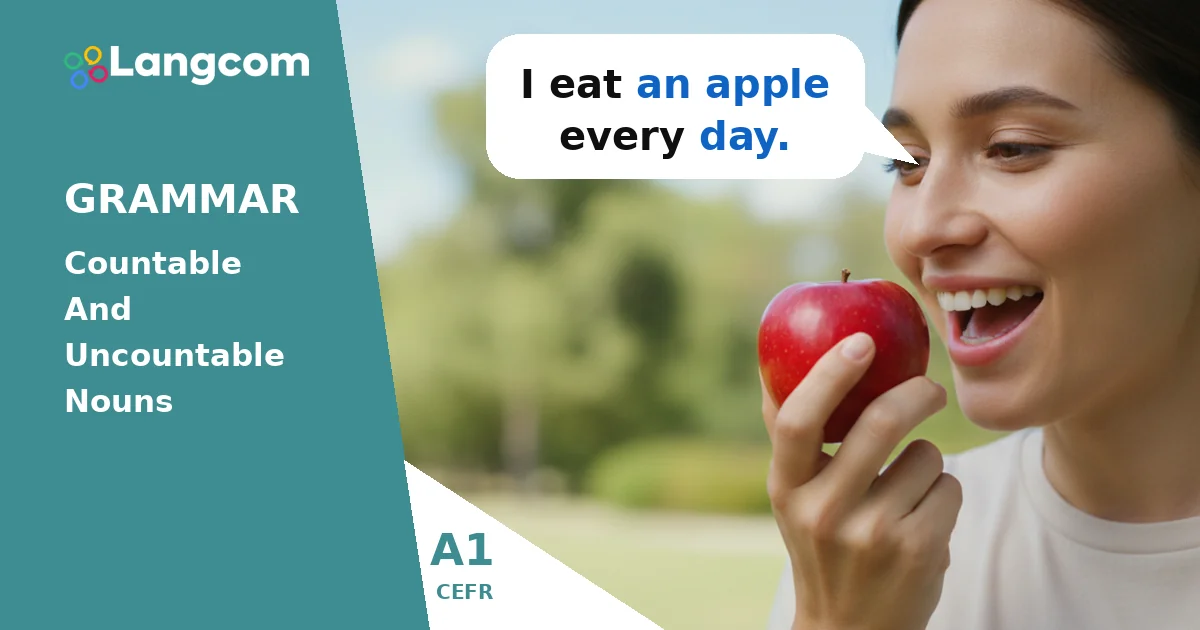
- I eat an apple every day.
- There are three books on the table.
- She has many friends.
- I need some water, please.
- There isn't much information about it.
- Do you have any milk?
- We have a lot of homework tonight.
- He drinks a little coffee in the morning.
Practice
💬 Need personalized guidance?
As an Authorized Cambridge Preparation Centre, we can guide you to the right course and certification. Chat with our advisors today.
Chat with an Advisor on WhatsAppCommon mistakes for Spanish speakers
Spanish speakers sometimes make these mistakes:
- Adding -s to uncountable nouns:
WRONG: I need some informations.
RIGHT: I need some information. (Information is uncountable) - Using a/an with uncountable nouns:
WRONG: Can I have a water?
RIGHT: Can I have some water? or Can I have a glass of water? - Confusing much and many:
WRONG: I have much friends.
RIGHT: I have many friends. (Friends are countable)
Frequently asked questions
Can I make an uncountable noun countable?
Yes, you can use words like a piece of, a slice of, a bottle of, or a cup of. For example, a glass of water or a slice of bread.
Is 'fruit' countable or uncountable?
Generally, fruit is uncountable when you talk about it in general, like I like fruit. However, when talking about different types of fruit, it can be countable, like There are many fruits in the market.
Why is 'money' uncountable?
Money is an abstract concept. We don't count 'moneys'. We count units of money, like dollars, euros, or coins. So, we say How much money? not How many money?
What about 'food'?
Similar to fruit, food is generally uncountable when talking about it in general, like I need some food. If you mean different types of food, it can sometimes be countable, but this is less common for A1 learners.

0 Comments