
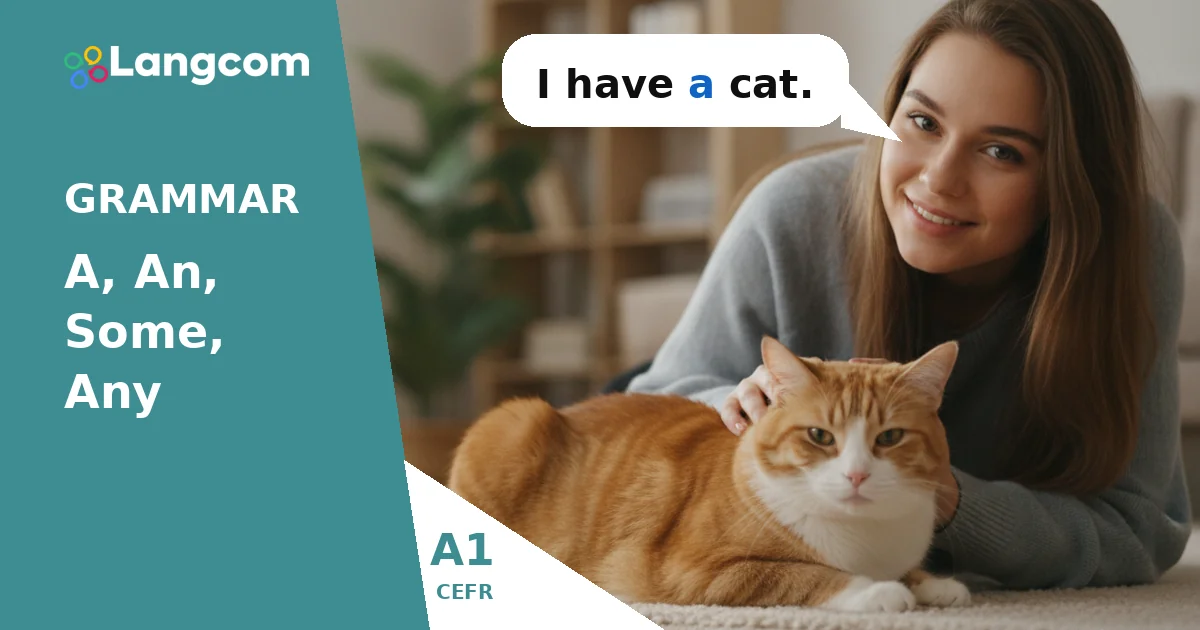

When Do We Use ‘A’ and ‘An’?
我们使用 a 和 an when we talk about one person, animal, or thing. These words are only for singular countable nouns.
- 使用 a before words that start with a consonant sound.
- 使用 an before words that start with a vowel sound (a, e, i, o, u).
How Do We Use 'Some'?
我们使用 some when we talk about an indefinite (not exact) quantity. It can be a small or large quantity.
- 使用 some with plural countable nouns in positive sentences.
- 使用 some with uncountable nouns in positive sentences.
- We also use some in questions when we offer something or ask for something.
How Do We Use 'Any'?
我们使用 any when we talk about an indefinite quantity, similar to some. 然而,, any has different rules for sentence types.
- 使用 any with plural countable nouns in negative sentences.
- 使用 any with uncountable nouns in negative sentences.
- 使用 any with plural countable nouns in questions.
- 使用 any with uncountable nouns in questions.
| Determiner | Noun Type | Sentence Type | 示例 |
|---|---|---|---|
| A / An | Singular Countable | Positive | I have a pen. / She eats an apple. |
| Some | Plural Countable | Positive | We have some books. |
| Some | Uncountable | Positive | I need some water. |
| Some | Plural Countable / Uncountable | Offer / Request | Would you like some cookies? |
| Any | Plural Countable | Negative | They don't have any children. |
| Any | Uncountable | Negative | There isn't any sugar. |
| Any | Plural Countable | Question | Do you have any friends? |
| Any | Uncountable | Question | Is there any coffee? |
示例
- I have a cat.
- She needs an umbrella.
- We bought some apples.
- There is some milk in the fridge.
- Would you like some tea?
- I don't have any brothers or sisters.
- There isn't any sugar.
- Do you have any questions?
练习
西班牙语母语者常犯的错误
讲西班牙语的人有时会犯以下错误:
- 使用 some 而不是 a/an for a single item:
I have some car. ❌
I have a car. ✅ - 使用 a/an with plural or uncountable nouns:
I need an advice. ❌
I need some advice. ✅
I have a friends. ❌
I have some friends. ✅ - 使用 some in negative sentences or general questions:
I don't have some money. ❌
I don't have any money. ✅
Do you have some questions? ❌ (unless offering)
Do you have any questions? ✅
常见问题
What is the main difference between 'a/an' and 'some/any'?
The main difference is quantity. We use a 和 an for one singular countable noun. We use some 和 any for more than one (plural countable nouns) or for things we cannot count (uncountable nouns).
Can I use 'some' in questions?
是的,你可以使用 some in questions, but only when you are offering something or making a request. For example, Would you like some coffee? (offer) or Can I have some water, please? (request).
When should I use 'any' instead of 'some'?
You should use any in negative sentences and in most general questions. For example, I don't have any brothers (negative) or Is there any milk? (general question).

0 条评论