
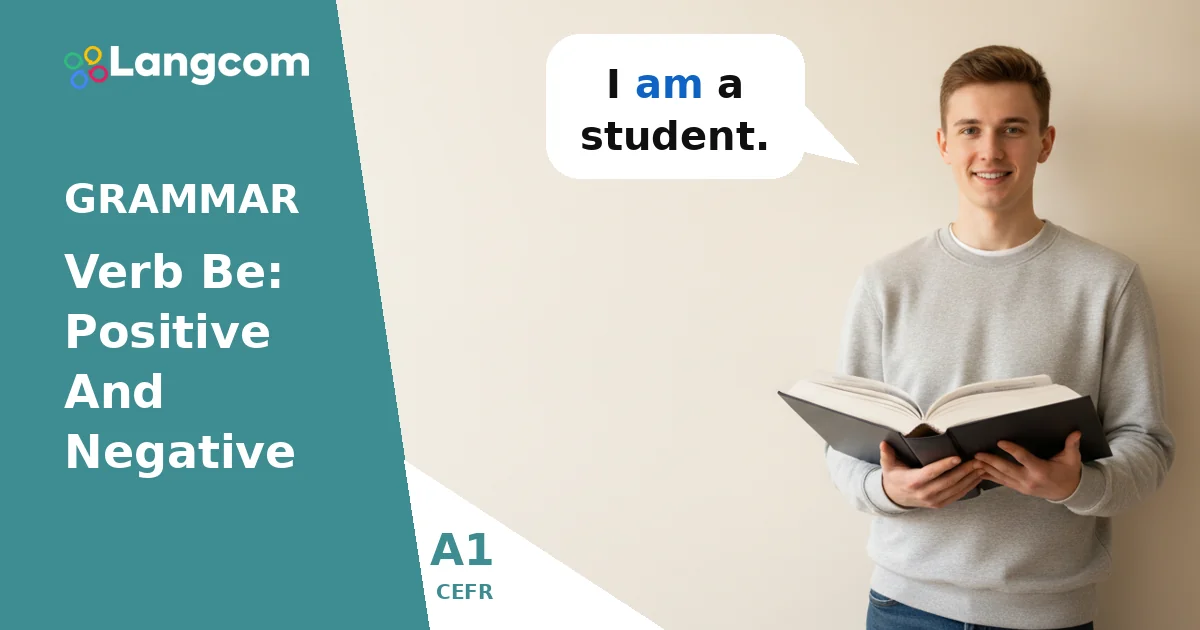

What is the verb “be” in English?
The verb be is fundamental in English. It is like ‘ser’ and ‘estar’ in Spanish, meaning it covers both concepts.
Мы используем be to talk about many things:
- Identity: Who someone is or what something is.
- Расположение: Where someone or something is.
- Description: What someone or something is like (their qualities or feelings).
🎓 Изучайте английский по смешанной методике
Небольшие группы · ИИ-репетитор 24/7 · Подготовка к экзаменам Кембриджского университета
Планы от $39 $79 в месяц
How do we use “be” in positive sentences?
The verb be changes its form depending on the subject (the person or thing doing the action).
- For I, we use am.
- For he, she, it (singular subjects), we use is.
- For you, we, they (plural subjects), we use are.
We often use contractions (shorter forms) in spoken English and informal writing. For example, I am becomes I’m.
How do we make “be” negative?
To make a sentence with the verb be negative, we simply add the word not after am, is, или are.
- I am not
- He is not
- They are not
We also have negative contractions. For example, is not becomes isn’t. For I am not, the contraction is usually I’m not.
When do we use contractions with “be”?
Contractions are very common in everyday English. You will hear them all the time when people speak.
- Speaking: Always use contractions when you speak. It sounds more natural.
- Informal Writing: Use contractions in emails to friends, text messages, or informal notes.
- Formal Writing: In formal writing, like academic essays or official reports, it is better to use the full forms (I am, she is not).
| Тема | Positive Form | Отрицательная форма | Positive Contraction | Negative Contraction |
|---|---|---|---|---|
| I | am | am not | I’m | I’m not |
| You | are | are not | You’re | You aren’t |
| He | is | is not | He’s | He isn’t |
| She | is | is not | She’s | She isn’t |
| It | is | is not | It’s | It isn’t |
| We | are | are not | We’re | We aren’t |
| They | are | are not | They’re | They aren’t |
Примеры
- I am a student.
- She is from Spain.
- They are happy.
- It is cold today.
- I’m not tired.
- He isn’t here.
- We aren’t doctors.
- You’re a good friend.
- They’re not at home.
- It’s not a big problem.
Практика
💬 Нужна индивидуальная консультация?
Являясь официальным центром подготовки к экзаменам Кембриджского университета, мы поможем вам выбрать подходящий курс и программу сертификации. Свяжитесь с нашими консультантами уже сегодня.
Общайтесь с консультантом в WhatsAppРаспространенные ошибки у носителей испанского языка
Spanish speakers sometimes forget to use the verb be. In Spanish, you might say ‘Yo feliz’ but in English, you must say I am happy. Always remember to include am, is, или are.
Another common mistake is confusing ser и estar. In English, be covers both. For example, I am a student (ser) and I am in the classroom (estar) both use am.
Also, make sure the verb matches the subject. It is She is, а не She are. Always check the subject to choose the correct form of be.
Часто задаваемые вопросы
What does the verb “be” mean in English?
The verb be in English means both ‘ser’ and ‘estar’ from Spanish. It is used to talk about identity, location, and descriptions.
Why are there three forms: am, is, and are?
The verb be changes its form to agree with the subject of the sentence. Am is for I, is is for singular subjects (he, she, it), and are is for plural subjects (you, we, they).
Can I always use contractions with the verb “be”?
You can almost always use contractions (I’m, isn’t, aren’t) in spoken English and informal writing. For formal writing, it is better to use the full forms (I am, is not, are not).
Is ‘be’ an irregular verb?
Да, be is an irregular verb. Its present tense forms (am, is, are) do not follow a regular pattern, unlike most other verbs.


0 Комментариев