

What Are Adjectives?
Adjectives are words that tell us more about a noun. They answer questions like: “What kind?” “Which one?” ou “How many?”
- They give us extra information about people, objects, and situations.
- For example, in “a funny story,” the word “funny” describes the story.
✍️ Not sure which level you are?
Take our free placement test and get personalized feedback from certified Cambridge examiners.
Faça nosso teste de nivelamento GRATUITOHow Do We Use Adjectives in English?
There are two main ways to use adjectives in English sentences:
- Before a noun: The adjective comes directly before the noun it describes. For example, "She has a special talent."
- After the verb 'to be' (or other linking verbs): The adjective describes the subject of the sentence. For example, "I am worried."
Adjectives for Feelings
We use these adjectives to talk about emotions and how people feel:
- Angry: Feeling strong displeasure or hostility. "He was angry about the delay."
- Worried: Feeling anxious or uneasy about something. "She felt worried about the exam."
- Pleased: Feeling happy or satisfied. "I am pleased with your progress."
- Sorry: Feeling regret or sadness. "I'm sorry I'm late."
- Sick: Feeling ill or unwell. "He stayed home because he was sick."
Adjectives to Describe People, Things, and Situations
These adjectives help us give more details about nouns:
- Special: Better, greater, or different from what is usual. "This is a special day for me."
- Funny: Causing laughter or amusement. "The film was very funny."
- Wrong: Not correct or true. "Your answer is wrong."
- Popular: Liked by many people. "This song is very popular right now."
- Free: Not busy; available; or costing no money. "Are you free tomorrow?"
- True: In accordance with fact or reality. "Is that story true?"
- Boring: Not interesting; dull. "The book was so boring I fell asleep."
- Horrible: Very unpleasant or bad. "The weather was horrible yesterday."
- Lucky: Having good things happen by chance. "You are so lucky to win!"
- Amazing: Causing great surprise or wonder. "The view from the mountain was amazing."
- Different: Not the same as another or each other. "These two shirts are different colors."
Why Are Adjectives Important for A2 Key (KET)?
For the A2 Key exam, you need to describe people, places, and daily life. Adjectives help you do this effectively.
- In the Speaking Part 1, you might describe your hobbies or hometown.
- In the Writing Part 6, you might write an email describing a friend or a recent event.
- Using a variety of adjectives shows you have a good range of vocabulary.
Exemplos
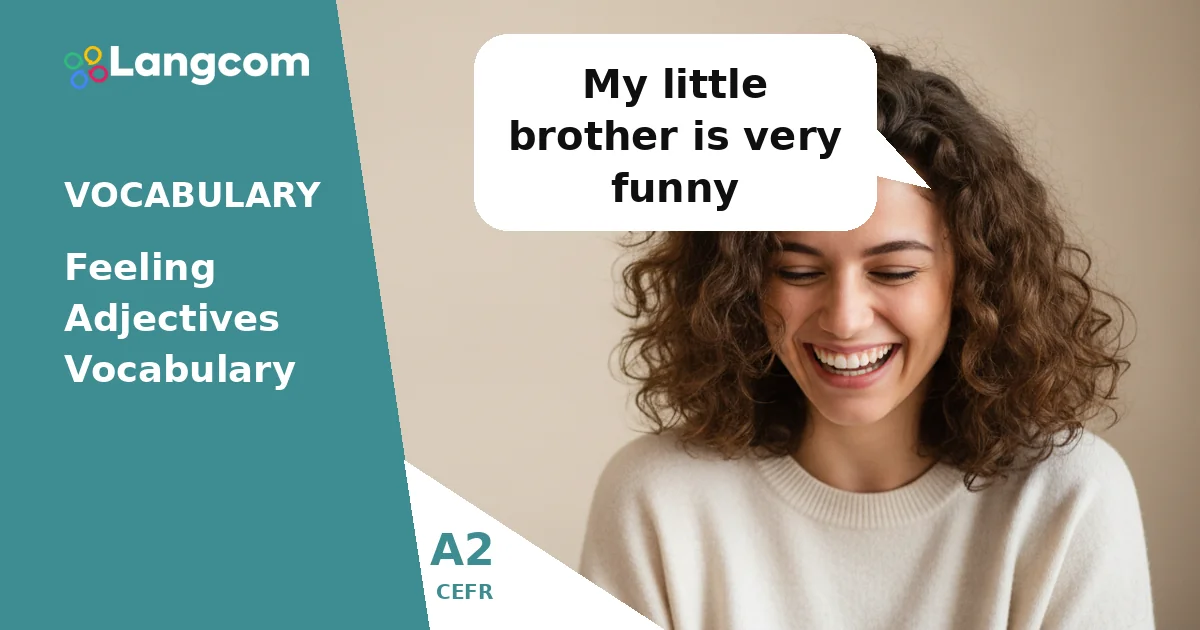
- My little brother is very funny.
- I think I gave the wrong answer.
- That singer is very popular in my country.
- I'm sorry, I can't help you today.
- Are you free this evening?
- I feel sick, I need to rest.
- Is it true that you're moving?
- The lecture was so boring.
- What a horrible smell!
- Don't be angry with me.
- You're so lucky to have such good friends.
- I'm worried about the test tomorrow.
- My parents were pleased with my exam results.
- That was an amazing concert!
- My new phone is very different from my old one.
Prática
Ready to earn your certificate?
Langcom prepares students for Cambridge, IELTS, TOEFL, DELE, SIELE and Michigan exams.
Get started with LangcomErros comuns entre falantes de espanhol
Spanish speakers sometimes make these mistakes with adjectives:
- Adjective position: In Spanish, adjectives often come after the noun. In English, they usually come before.
WRONG: "I have a car red."
RIGHT: "I have a red car." - Using 'very' with strong adjectives: Some adjectives already mean 'very + adjective' (e.g., amazing means 'very good').
WRONG: "The film was very amazing."
RIGHT: "The film was amazing." - Confusing -ed and -ing adjectives: For example, "boring" describes the thing that makes you bored, while "bored" describes how you feel.
WRONG: "I am boring." (This means YOU are a boring person.)
RIGHT: "I am bored." (This means you feel bored.)
Perguntas frequentes
What is an adjective?
An adjective is a word that describes a noun (a person, place, thing, or idea). It gives more information about the noun, like its size, color, or how it feels. For example, in "a big house," "big" is the adjective.
Can adjectives describe feelings?
Yes, many adjectives describe feelings! Words like "angry," "worried," e "pleased" tell us how someone feels. For example, "She is happy."
Where do adjectives usually go in an English sentence?
Adjectives usually go in two places: before a noun (e.g., "a special gift") or after the verb "to be" (e.g., "The gift is special.").
How do adjectives help me in the A2 Key (KET) exam?
Adjectives are very important for the A2 Key exam! They help you describe things clearly in the Speaking and Writing parts. For example, you can describe your favorite food as "delicious" or a trip as "amazing."



0 Comentários