
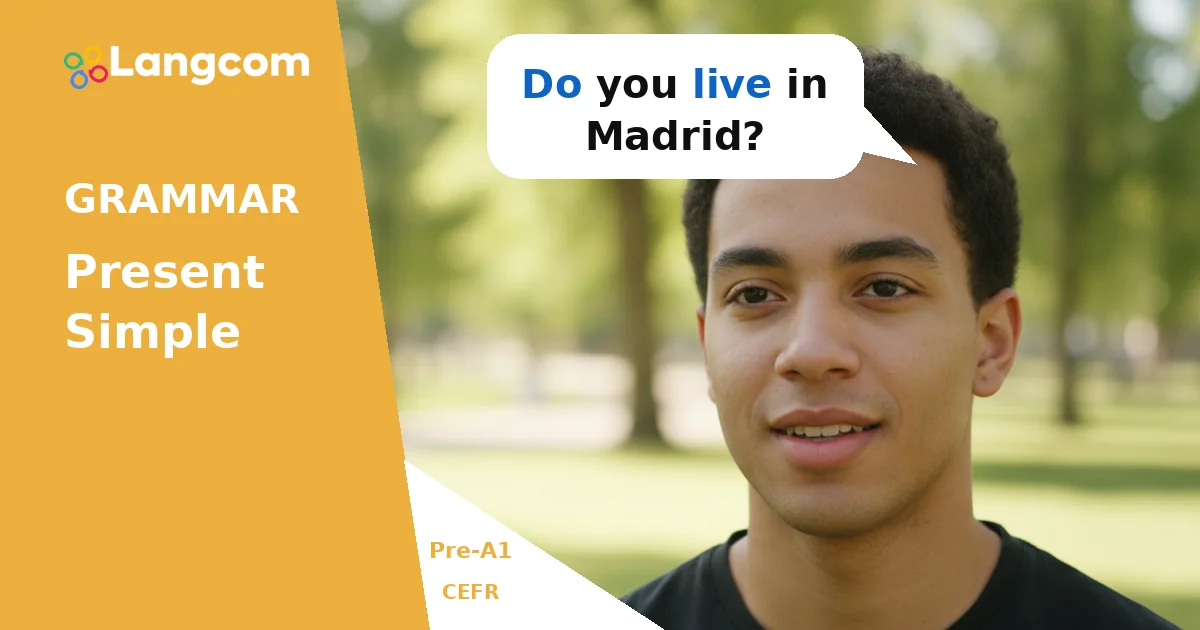

How to Ask ‘Yes’ or ‘No’ Questions
To ask a question that can be answered with ‘yes’ or ‘no’ in the present simple, we need a special word at the beginning.
We use do oppure does to start the question. The main verb always stays in its base form.
- Use do with: I, you, we, they (and plural nouns like students, cats).
- Use does with: he, she, it (and singular nouns like my friend, the dog).
The basic structure is: Do/Does + Subject + Base Form of Verb + …?
🎓 Impara l'inglese con il metodo misto
Piccoli gruppi · Tutor IA disponibile 24 ore su 24, 7 giorni su 7 · Preparazione agli esami di Cambridge
Piani da $39 $79 al mese
How to Give Short Answers
When someone asks a ‘yes’ or ‘no’ question, you can give a short answer. This is polite and common in English.
The short answer uses do oppure does again, not the main verb.
- For ‘Yes’ answers: Yes, + Subject + do/does.
- For ‘No’ answers: No, + Subject + don’t/doesn’t. (don’t is do not; doesn’t is does not).
Questions with ‘Wh-‘ Words (Information Questions)
Sometimes you want more information, not just ‘yes’ or ‘no’. For these questions, we use ‘Wh-‘ words like what, where, when, why, who.
The ‘Wh-‘ word comes first, then do oppure does, then the subject, and then the base form of the verb.
The structure is: Wh- word + do/does + Subject + Base Form of Verb + …?
| Subject | Question | Yes, Short Answer | No, Short Answer |
|---|---|---|---|
| I | Do I work? | Yes, I do. | No, I don’t. |
| You | Do you work? | Yes, you do. | No, you don’t. |
| He | Does he work? | Yes, he does. | No, he doesn’t. |
| She | Does she work? | Yes, she does. | No, she doesn’t. |
| It | Does it work? | Yes, it does. | No, it doesn’t. |
| We | Do we work? | Yes, we do. | No, we don’t. |
| They | Do they work? | Yes, they do. | No, they don’t. |
Examples
- Do you live in Madrid?
- Does she like coffee?
- Do they play football?
- Does he work on Saturdays?
- Do we have class today?
- What do you do?
- Where does she live?
- When do they eat dinner?
Practice
💬 Hai bisogno di una consulenza personalizzata?
In qualità di Centro autorizzato di preparazione agli esami Cambridge, possiamo aiutarti a scegliere il corso e la certificazione più adatti alle tue esigenze. Contatta oggi stesso i nostri consulenti.
Chatta con un consulente su WhatsAppCommon mistakes for Spanish speakers
Spanish speakers sometimes make these mistakes:
- Forgetting do oppure does: In Spanish, you often just change your voice to ask a question. In English, you must use do oppure does.
- You like coffee? (Incorrect)
- Do you like coffee? (Correct)
- Using is instead of do/does: Remember, is is for the verb ‘to be’. Do/does is for other actions.
- Is you like coffee? (Incorrect)
- Do you like coffee? (Correct)
- Adding -s to the main verb with does: When you use does, the main verb is always in its base form.
- Does he likes pizza? (Incorrect)
- Does he like pizza? (Correct)
Domande frequenti
Why do we use ‘do’ and ‘does’ for questions?
In English, do e does are ‘helping verbs’ that show it’s a question in the present simple. They don’t have a special meaning here; they just help form the question.
When do I use ‘do’ and when do I use ‘does’?
You use do for I, you, we, they and plural nouns. You use does for he, she, it and singular nouns.
Can I say ‘Yes, I like’ instead of ‘Yes, I do’?
It’s better to use the short answer Yes, I do. oppure No, I don’t. This is the natural and most common way to answer ‘yes/no’ questions in English.
Does the main verb change when I use ‘do’ or ‘does’?
No, the main verb always stays in its base form (the infinitive without ‘to’) when you use do oppure does in a question or a negative sentence. For example, Does she like…? non Does she likes…?

Frisse adult websites bieden geavanceerde inhoud voor volwassenen. Kies
voor betrouwbare frisse sites voor veilig kijken.
My website :: stepsister blowjob
I am regular visitor, how are you everybody? This piece of
writing posted at this web page is really pleasant.
Here is my web-site :: webpage
Volwassen inhoud vinden door betrouwbare adult platforms online te verkennen. Ontdek veilige sites voor een private ervaring.
流媒体成人内容 通过选择经过验证的成人网站来安全进行。使用 安全平台 以获得私密的娱乐体验。
my website 女性最佳性网站
Взрослый контент доступны на различных сайтах для взрослых
в развлекательных целях. Всегда выбирайте
безопасные платформы для
защищенного опыта.
Also visit my web page – шеймейл кончает
Платформа для откровенных материалов предлагает широкий выбор видео для взрослых развлечений.
Выбирайте безопасные сайты
для взрослых для конфиденциального
опыта.
Also visit my homepage :: buy valium online