

What is the Present Simple Negative?
The Present Simple Negative tells us what we do not do or what is not true.
It is for daily routines, facts, or things you don’t like.
- I don’t eat meat. (This is a fact about me.)
- She doesn’t work on Sundays. (This is her routine.)
🎓 Impara l'inglese con il metodo misto
Piccoli gruppi · Tutor IA disponibile 24 ore su 24, 7 giorni su 7 · Preparazione agli esami di Cambridge
Piani da $39 $79 al mese
How do we form the Present Simple Negative?
We use do not oppure does not with the base form of the verb.
- Subject + do not / does not + base verb.
The short forms are don’t e doesn’t. These are very common in spoken English.
When do we use ‘don’t’?
We use don’t when the subject is:
- I
- You
- We
- They
The verb after don’t is always the base form (e.g., like, play, go).
When do we use ‘doesn’t’?
We use doesn’t when the subject is:
- He
- She
- It
The verb after doesn’t is also always the base form. Remember, we do not add ‘-s’ to the verb here.
What are the short forms?
In English, we often use short forms to speak faster and sound more natural.
- do not becomes don’t
- does not becomes doesn’t
Both long and short forms are correct, but short forms are more common in everyday conversation.
| Subject | Negative Form | Verb (Base Form) |
|---|---|---|
| I | don’t | like |
| You | don’t | like |
| He | doesn’t | like |
| She | doesn’t | like |
| It | doesn’t | like |
| We | don’t | like |
| They | don’t | like |
Esempi
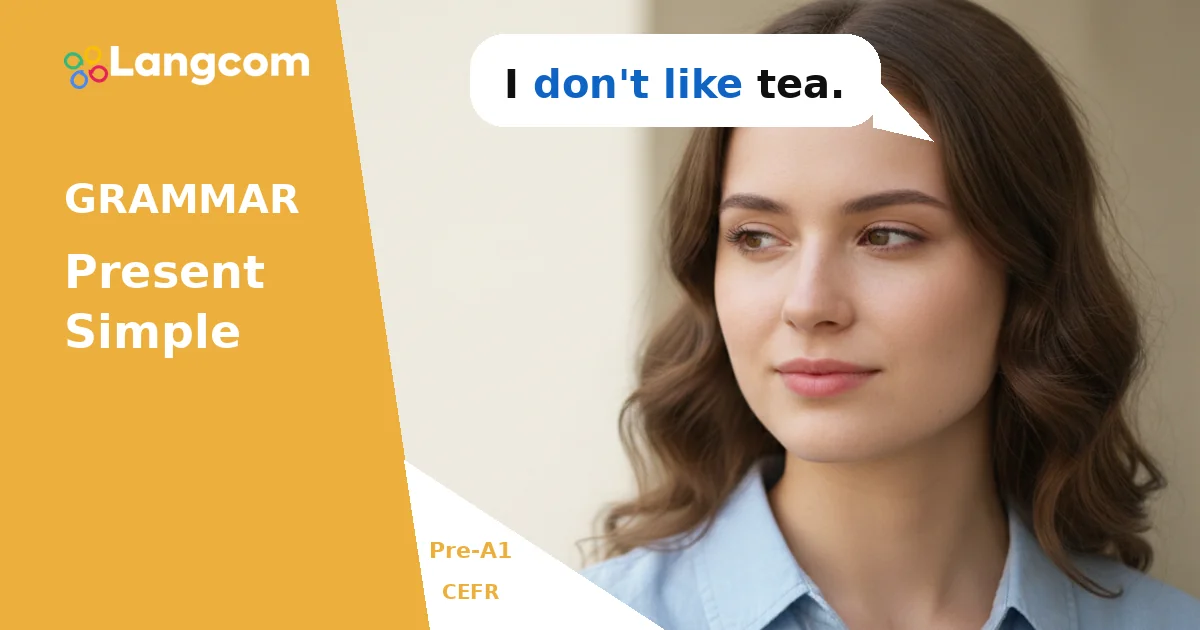
- I don’t like tea.
- You don’t speak French.
- He doesn’t live in London.
- She doesn’t play tennis.
- It doesn’t rain much here.
- We don’t watch TV in the morning.
- They don’t work on Saturdays.
Esercitazione
💬 Hai bisogno di una consulenza personalizzata?
In qualità di Centro autorizzato di preparazione agli esami Cambridge, possiamo aiutarti a scegliere il corso e la certificazione più adatti alle tue esigenze. Contatta oggi stesso i nostri consulenti.
Chatta con un consulente su WhatsAppErrori comuni per chi parla spagnolo
A common mistake for Spanish speakers is to put no directly before the verb, like in Spanish.
- Errato: I no like coffee.
- Corretto: I don’t like coffee.
Another mistake is to add ‘-s’ to the verb after doesn’t.
- Errato: She doesn’t likes pizza.
- Corretto: She doesn’t like pizza.
Always remember to use don’t oppure doesn’t and the base form of the verb.
Domande frequenti
What does ‘don’t’ mean?
Don’t is the short form of do not. It means ‘not do’ or ‘not have’ for actions and facts in the present.
What does ‘doesn’t’ mean?
Doesn’t is the short form of does not. It means ‘not do’ or ‘not have’ for actions and facts in the present, specifically for he, she, e it.
Can I say ‘do not’ instead of ‘don’t’?
Yes, you can say do not. It means the same as don’t. Do not is more formal, while don’t is more common in everyday speaking and informal writing.
Why do we use ‘do’ or ‘does’ in negative sentences?
In inglese, do e does are ‘helper verbs’ for negative sentences and questions in the Present Simple. They help us make the sentence negative with not. We cannot just put not after the subject.



0 Commenti