
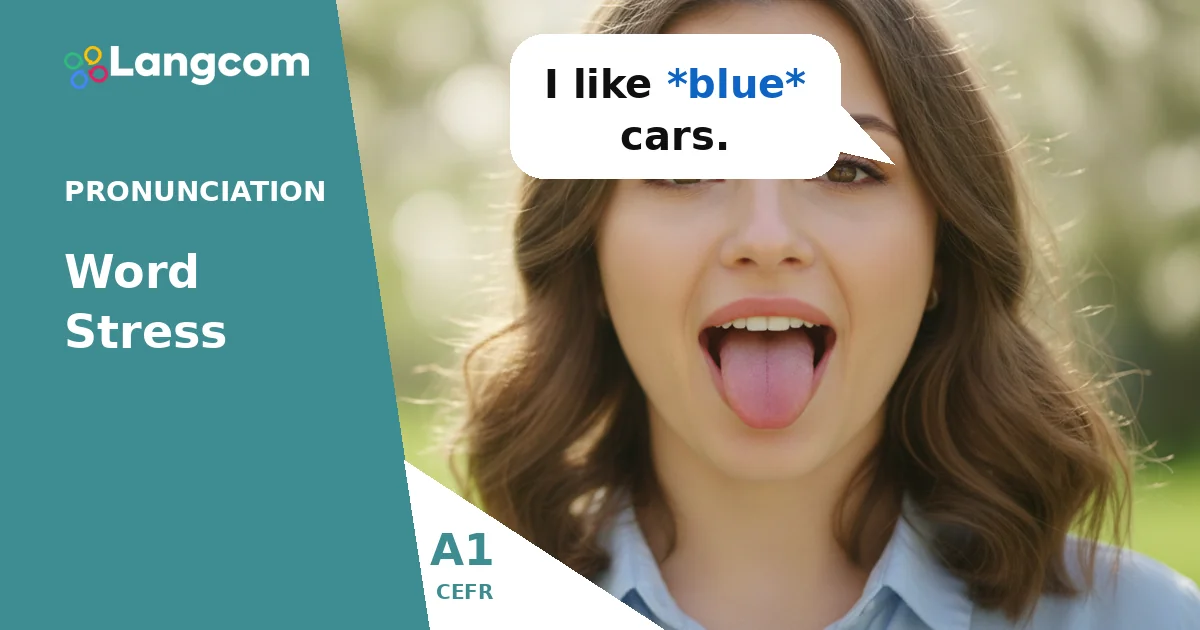

What is Main Stress in an English Sentence?
When we speak English, we do not say every word with the same power. Some words are more important than others in a sentence.
Il main stress is when one word in a sentence is pronounced more strongly. This word is usually louder, a little longer, and has a slightly higher pitch.
- For example, in I like to eat APPLES, the word APPLES is the most important. It tells us what you like to eat.
- The other words are still important, but APPLES gets the special attention.
🎓 Impara l'inglese con il metodo misto
Piccoli gruppi · Tutor IA disponibile 24 ore su 24, 7 giorni su 7 · Preparazione agli esami di Cambridge
Piani da $39 $79 al mese
Why is Main Stress Important for Your English?
Using main stress helps people understand you better. It shows them what information is new or most important in your message.
- Clearer Meaning: It helps you communicate your exact message.
- Natural Sound: Your English will sound more like a native speaker's.
- Better Understanding: You will also understand others more easily when they use stress.
Which Words Usually Get Main Stress?
Often, the main stress goes on words that carry new or important information. These are usually nouns, main verbs, adjectives, and adverbs.
However, any word can get main stress if you want to emphasize it. This happens when you want to correct something or show a strong feeling.
- Content Words: Words like book (noun), run (main verb), happy (adjective), quickly (adverb) often get stress.
- Function Words: Smaller words like a, the, is, to, he usually do not get main stress.
- Emphasis: Sometimes, you stress a function word to change the meaning. For example, I said TO him, not FROM him.
How Can You Practice Main Stress?
The best way to learn main stress is to listen and repeat. Pay attention to how native speakers emphasize words.
- Listen Actively: When you hear English, try to identify the loudest word in each sentence.
- Repeat and Imitate: Practice saying sentences, trying to copy the stress patterns you hear.
- Think About Meaning: Before you speak, think about the most important word in your sentence. This word should receive the main stress.
| Sentence | Stressed Word | Meaning |
|---|---|---|
| She bought a *red* dress. | red | The dress was red, not another color. |
| *She* bought a red dress. | She | She bought it, not someone else. |
| She *bought* a red dress. | bought | She purchased it, she didn't just look at it. |
| She bought a red *dress*. | dress | She bought a dress, not a skirt or shirt. |
Esempi
- I like *blue* cars. (This means I like blue ones, not red ones.)
- *I* like blue cars. (This means *I* like them, not someone else.)
- I *like* blue cars. (This means I really do like them, it's true.)
- I like blue *cars*. (This means I like cars, not blue trucks or bikes.)
- Did you ask *when* you're going to lose your job? (The speaker emphasizes the time of losing the job.)
- Maybe there'll be *other* jobs there. (The speaker emphasizes the possibility of different jobs.)
Esercitazione
💬 Hai bisogno di una consulenza personalizzata?
In qualità di Centro autorizzato di preparazione agli esami Cambridge, possiamo aiutarti a scegliere il corso e la certificazione più adatti alle tue esigenze. Contatta oggi stesso i nostri consulenti.
Chatta con un consulente su WhatsAppErrori comuni per chi parla spagnolo
Spanish is a syllable-timed language, meaning syllables often have similar length and stress. English is a stress-timed language, where some syllables are long and strong, and others are short and weak.
- Mistake: Spanish speakers might stress every word in an English sentence equally, or stress the wrong word. For example, saying I AM GOING TO THE BANK with equal stress on every word.
- Correction: Focus on stressing only the most important word. For example, I'm going to the *BANK*. (The bank is the important destination.) Or *I'm* going to the bank. (I am, not you.)
Domande frequenti
What is the difference between 'word stress' and 'main stress' in a sentence?
Word stress is about which syllable in a single word is strongest (e.g., TEAcher). Main stress (or sentence stress) is about which *word* in a whole sentence is strongest because it carries the most important meaning (e.g., I want the *RED* book).
How can I know which word to stress in a sentence?
Think about the most important piece of new information you want to share. That word will usually get the main stress. If you are correcting someone or showing a strong feeling, you can stress almost any word to emphasize it.
Does main stress change the meaning of a sentence?
Yes, absolutely! Changing the main stress can completely change what your sentence means. For example, *She* bought a new car means she did it, not someone else. But She bought a *new* car means the car is not old.
Is main stress important for English exams?
While specific A1 exams might not test main stress directly, good pronunciation, including correct stress, helps you communicate clearly. This can contribute to higher scores in speaking sections by making your English easier to understand.


0 Commenti