

What are the most common colours in English?
There are many colours in the world! Here are some of the most common and useful colours to learn first:
- Red: Think of an apple or a stop sign.
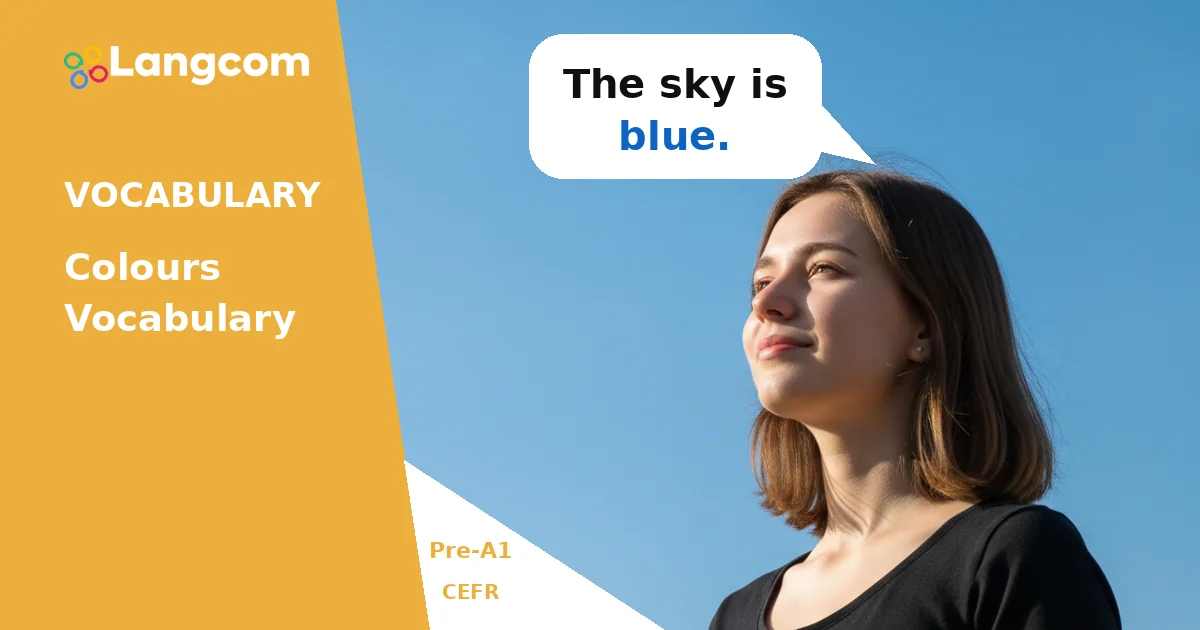
- Blue: Like the sky on a sunny day or the ocean.
- Yellow: Like the sun or a banana.
- Green: Like grass or the leaves on a tree.
- Orange: Like the fruit or a carrot.
- Purple: Like grapes or some flowers.
- Pink: Like a pig or some sweet candy.
- Brown: Like chocolate or wood.
- Black: Like the night sky or a car tire.
- White: Like snow or milk.
- Grey: Like a cloud on a rainy day.
🎓 Impara l'inglese con il metodo misto
Piccoli gruppi · Tutor IA disponibile 24 ore su 24, 7 giorni su 7 · Preparazione agli esami di Cambridge
Piani da $39 $79 al mese
How do we use colours in sentences?
You can use colours in two main ways to describe things in English:
- Before the noun: Put the colour word directly before the thing it describes. This is like saying a red car.
- With the verb ‘to be’: Use the verb is oppure are to say what colour something is. This is like saying The car is red.
What are primary and secondary colours?
Some colours are basic, and some are made by mixing. Let’s learn about them:
- Primary Colours: These are the basic colours. You cannot make them by mixing other colours. The primary colours are red, yellow, e blue.
- Secondary Colours: You make these colours by mixing two primary colours.
- Red + Yellow = Orange
- Yellow + Blue = Green
- Red + Blue = Purple
| Colour | Example Object |
|---|---|
| Red | Apple |
| Blue | Sky |
| Yellow | Sun |
| Green | Grass |
| Orange | Orange (fruit) |
| Purple | Grapes |
| Pink | Flower |
| Brown | Chocolate |
| Black | Night |
| White | Snow |
| Grey | Cloud |
Examples
- The sky is blue.
- I have a red car.
- The banana is yellow.
- Look at the green tree.
- My favourite colour is orange.
- She has a pink dress.
Practice
💬 Hai bisogno di una consulenza personalizzata?
In qualità di Centro autorizzato di preparazione agli esami Cambridge, possiamo aiutarti a scegliere il corso e la certificazione più adatti alle tue esigenze. Contatta oggi stesso i nostri consulenti.
Chatta con un consulente su WhatsAppCommon mistakes for Spanish speakers
A common mistake for Spanish speakers is placing the colour word after the noun. In Spanish, you might say ‘el coche rojo’ (the car red).
In English, the colour usually comes prima the noun:
- Wrong: The car red.
- Correct: The red car.
Or, you can use the verb to be:
- Wrong: The car is of red.
- Correct: The car is red.
Domande frequenti
Why is it important to learn colours in English?
Learning colours helps you describe many things around you. You can talk about clothes, food, nature, and objects. It makes your English richer and helps you communicate more clearly.
How can I remember new colour words?
The best way is to practice! Look around your room or classroom. Say the colour of objects you see. For example, The wall is white. My book is blue. Practice helps you remember them easily.
Are there other colours to learn?
Yes, there are many more colours! But the ones in this lesson are the most common and important for beginners. As you learn more English, you can discover new colours like turquoise oppure magenta.




0 Commenti