

How Do We Form Questions with ‘To Be’?
To make a question with the verb to be, we change the word order. We put the verb to be (am, is, or are) at the beginning of the sentence, before the subject.
- For statements like I am a student., the question is Am I a student?
- For statements like She is happy., the question is Is she happy?
- For statements like They are friends., the question is Are they friends?
🎓 Apprenez l'anglais grâce à la méthode mixte
Petits groupes · Tuteur IA disponible 24 h/24, 7 j/7 · Préparation aux examens de Cambridge
Plans provenant de $39 $79 par mois
What Are the Forms of ‘To Be’ Questions?
The form of to be depends on the subject. There are three main forms for questions:
- Am + I + …?
- Is + he/she/it + …?
- Are + you/we/they + …?
Remember to always use the correct form of to be for each subject.
How Do We Give Short Answers to ‘To Be’ Questions?
When someone asks a to be question, you can give a short answer. These answers are simple and direct.
- For positive answers, use Yes, + subject + am/is/are.
- For negative answers, use No, + subject + am not/isn’t/aren’t.
It is common to use contractions for negative short answers (isn’t, aren’t). For I am not, we usually say I’m not.
| Subject | Question | Positive Answer | Negative Answer |
|---|---|---|---|
| I | Am I tired? | Yes, I am. | No, I’m not. |
| he | Is he tired? | Yes, he is. | No, he isn’t. |
| she | Is she tired? | Yes, she is. | No, she isn’t. |
| it | Is it tired? | Yes, it is. | No, it isn’t. |
| you | Are you tired? | Yes, you are. | No, you aren’t. |
| we | Are we tired? | Yes, we are. | No, we aren’t. |
| they | Are they tired? | Yes, they are. | No, they aren’t. |
Exemples
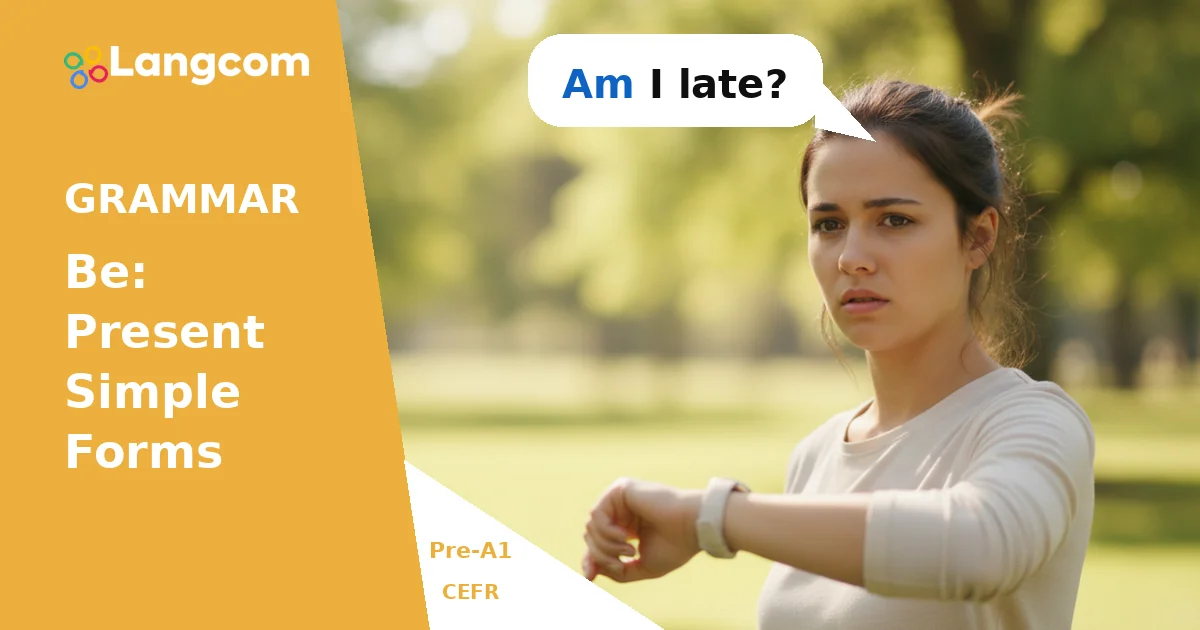
- Am I late?
- Is he a doctor?
- Is she from Spain?
- Is it cold today?
- Are you happy?
- Are we ready?
- Are they students?
- Yes, I am.
- No, he isn’t.
- Yes, we are.
- No, they aren’t.
Entraînement
💬 Vous avez besoin de conseils personnalisés ?
En tant que centre de préparation agréé par Cambridge, nous pouvons vous aider à choisir la formation et la certification qui vous conviennent. Discutez-en dès aujourd'hui avec nos conseillers.
Discutez avec un conseiller sur WhatsAppErreurs courantes chez les hispanophones
Spanish speakers sometimes make a few common mistakes when forming questions with to be:
- Incorrect word order: In Spanish, you often keep the subject-verb order and just add a question mark. In English, you must invert.
- Wrong: You are happy?
- Right: Are you happy?
- Using ‘do/does’: Do ou does are for other verbs, not for to be.
- Wrong: Do you are a student?
- Right: Are you a student?
- Missing the verb: Sometimes the verb to be is omitted.
- Wrong: He tired?
- Right: Is he tired?
Questions fréquemment posées
Why do we change the word order for questions with ‘to be’?
In English, changing the word order (inversion) is the main way to show that a sentence is a question, especially with to be. It helps the listener understand you are asking something.
Can I use contractions in short answers?
Yes, it is very common to use contractions for negative short answers, like No, I’m not., No, he isn’t., No, they aren’t. For positive short answers, we usually do not use contractions: Yes, I am. (not Yes, I’m.).
Is ‘to be’ used for all types of questions?
No, to be is used for questions about identity (Are you John?), descriptions (Is it big?), feelings (Are you sad?), and locations (Is he here?). For questions with other verbs (like eat, work), you use do ou does.

0 commentaire