

Why is it Important to Learn Body Parts in English?
Learning the names of body parts is very useful for daily life. It helps you communicate in many situations.
- You can describe people: She has long hair and blue eyes.
- You can talk about your health: My head hurts.
- You can follow simple instructions: Touch your nose.
🎓 Apprenez l'anglais grâce à la méthode mixte
Petits groupes · Tuteur IA disponible 24 h/24, 7 j/7 · Préparation aux examens de Cambridge
Plans provenant de $39 $79 par mois
What are the Main Body Parts?
Here are some of the most common body parts you should know. We can divide them into different areas of the body.
Head and Face
- head: The top part of your body.
- eye: You use your eyes to see.
- ear: You use your ears to hear.
- nose: You use your nose to smell.
- mouth: You use your mouth to eat and speak.
Upper Body
- neck: Connects your head to your body.
- hand: The end part of your arm.
- finger: You have five fingers on each hand.
- back: The rear part of your torso.
- stomach: The front part of your body where food goes.
Lower Body
- leg: You use your legs to walk and run.
- foot: The end part of your leg. You have two feet.
| Singular | Plural |
|---|---|
| head | heads |
| ear | ears |
| eye | eyes |
| mouth | mouths |
| nose | noses |
| neck | necks |
| finger | fingers |
| hand | hands |
| back | backs |
| stomach | stomachs |
| foot | feet |
| leg | legs |
Exemples
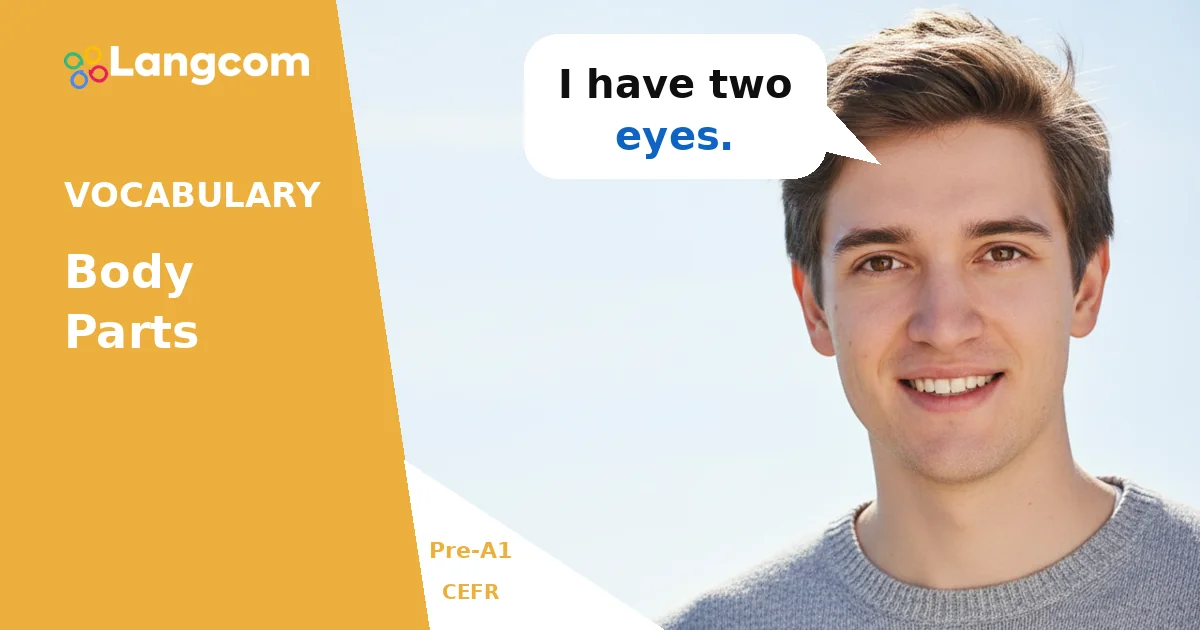
- I have two eyes.
- She has long hair on her head.
- My ears are cold.
- He has a small nose.
- Open your mouth.
- Turn your neck.
- I have five fingers on each hand.
- My back hurts.
- My stomach is full.
- Run with your legs.
- Kick the ball with your foot.
Entraînement
💬 Vous avez besoin de conseils personnalisés ?
En tant que centre de préparation agréé par Cambridge, nous pouvons vous aider à choisir la formation et la certification qui vous conviennent. Discutez-en dès aujourd'hui avec nos conseillers.
Discutez avec un conseiller sur WhatsAppErreurs courantes chez les hispanophones
A common mistake for Spanish speakers is with plural forms, especially irregular ones.
- Incorrect: I have two foot.
- Correct: I have two feet. (The plural of foot is feet, not foots.)
- Incorrect: She has two hand.
- Correct: She has two hands. (Remember to add -s for most plurals.)
Questions fréquemment posées
How do I ask about body parts?
You can ask, What is this? while pointing. For example, What is this? This is my hand.
Are there any irregular plural forms for body parts?
Yes, the most common irregular plural for body parts is foot, which becomes feet in the plural form.
How can I practice these new words?
You can point to your own body parts and say their English names. Also, try to describe people you see using these words in simple sentences.




0 commentaire