

What are the two main types of questions in English?
In English, we use questions to ask for information or to confirm something. There are two main types:
-
Yes/No Questions: These questions expect a “yes” or “no” answer. For example, Do you like pizza? (Answer: Yes, I do. ou No, I don’t.)
-
Wh- Questions: These questions ask for specific information. They start with a “Wh- word” like What, Where, When, Why, Who, Whose, ou How. For example, Where do you live? (Answer: I live in Madrid.)
✍️ Vous ne savez pas quel est votre niveau ?
Passez notre test de niveau gratuit et recevez des commentaires personnalisés de la part d'examinateurs certifiés par Cambridge.
Passez notre test de niveau GRATUITHow do I form Yes/No questions?
To make a Yes/No question, we usually change the word order of a statement. We put the auxiliary verb (like do, does, have, has) or the verb be (am, is, are) before the subject.
-
With the verb be (am, is, are):
-
Statement: You are happy.
-
Question: Are you happy?
-
Statement: She is a student.
-
Question: Is she a student?
-
-
With have got:
-
Statement: You have got a car.
-
Question: Have you got a car?
-
Statement: He has got a new phone.
-
Question: Has he got a new phone?
-
-
With modal verbs (can, must, should, etc.):
-
Statement: You can speak English.
-
Question: Can you speak English?
-
Statement: I must go now.
-
Question: Must I go now?
-
-
With other verbs (using do/does):
-
For most other verbs in the present simple, we use do ou does before the subject. The main verb stays in its base form.
-
Statement: You like coffee.
-
Question: Do you like coffee?
-
Statement: She works here.
-
Question: Does she work here?
-
How do I form Wh- questions?
Wh- questions ask for specific details. They always start with a "Wh- word" (or How), followed by an auxiliary verb or be, then the subject, and finally the main verb (if there is one).
-
Common Wh- words: What (things, actions), Where (places), When (time), Why (reasons), Who (people), How (manner, condition).
-
Structure: Wh- word + auxiliary verb / be + subject + main verb?
-
Examples with be:
-
What is your name?
-
Where are you from?
-
How old is he?
-
-
Examples with have got:
-
What have you got in your bag?
-
Who has got my pen?
-
-
Examples with modal verbs (can):
-
What can I do for you?
-
Where can we meet?
-
-
Examples with other verbs (using do/does):
-
What do you do?
-
Where does she work?
-
When do they finish?
-
How can I suggest things using questions?
Sometimes we use questions not to ask for information, but to suggest an idea or activity. These are common in everyday English.
-
Why don't we...? (followed by the base form of the verb)
-
Why don't we go to the cinema tonight?
-
Why don't you ask your teacher?
-
-
How about...? (followed by a noun or a verb ending in -ing)
-
How about a coffee?
-
How about going for a walk?
-
-
What about...? (similar to How about...?)
-
What about tomorrow morning?
-
What about watching a movie?
-
| Type de question | Verb | Structure | Exemple |
|---|---|---|---|
| Yes/No | Be | Be + Subject + ...? | Are you busy? |
| Yes/No | Have got | Have/Has + Subject + got + ...? | Have you got a pen? |
| Yes/No | Modal (can) | Modal + Subject + Base Verb + ...? | Can I help you? |
| Yes/No | Other verbs | Do/Does + Subject + Base Verb + ...? | Do you play sports? |
| Wh- | Be | Wh- word + Be + Subject + ...? | Where is he? |
| Wh- | Have got | Wh- word + Have/Has + Subject + got + ...? | What has she got? |
| Wh- | Modal (can) | Wh- word + Modal + Subject + Base Verb + ...? | When can we meet? |
| Wh- | Other verbs | Wh- word + Do/Does + Subject + Base Verb + ...? | Why do you study English? |
Exemples
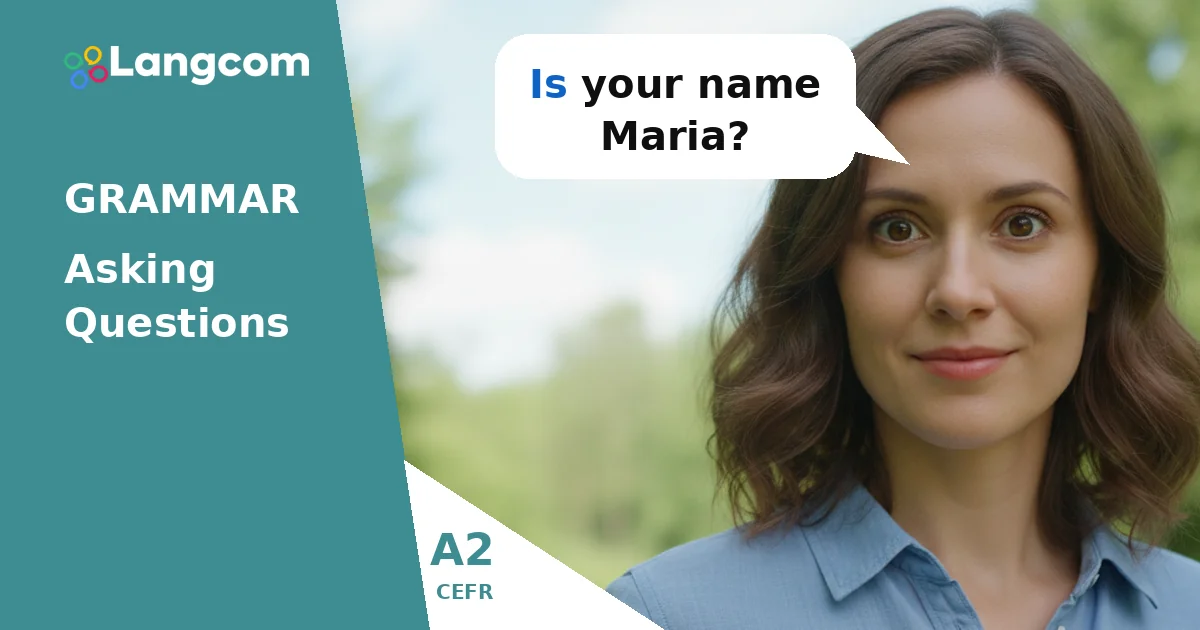
- Is your name Maria?
- Do you live in a big city?
- Has he got a pet?
- Can she play the guitar?
- What time is it?
- Where do you usually go on holiday?
- When does the shop open?
- Why are you learning English?
- How about visiting the museum?
Entraînement
Ready to earn your certificate?
Langcom prepares students for Cambridge, IELTS, TOEFL, DELE, SIELE and Michigan exams.
Get started with LangcomErreurs courantes chez les hispanophones
Spanish speakers sometimes make mistakes with word order when asking questions in English. Remember these key differences:
-
Incorrect word order (direct translation from Spanish): In Spanish, you can often say "You are happy?" with rising intonation. In English, you must change the word order.
-
Wrong: You are happy?
-
Right: Are you happy?
-
-
Missing do/does: For most verbs in the present simple (except be, have got, and modal verbs), you need do ou does.
-
Wrong: You like coffee?
-
Right: Do you like coffee?
-
Wrong: She works here?
-
Right: Does she work here?
-
-
Incorrect placement of auxiliary verb in Wh- questions: The auxiliary verb always comes after the Wh-word and avant the subject.
-
Wrong: Where you live?
-
Right: Where do you live?
-
Wrong: What is your name is? (Redundant 'is')
-
Right: What is your name?
-
Questions fréquemment posées
What is the main difference between Yes/No and Wh- questions?
Yes/No questions ask for a simple "yes" or "no" answer, like Are you ready? Wh- questions ask for specific information and start with words like What, Where, ou When, for example, What is your favourite colour?
Why do I need to use 'do' or 'does' in some questions?
Nous utilisons do ou does as auxiliary verbs for most verbs in the present simple tense when forming questions (and negatives). For example, Do you like chocolate? ou Does she speak French? We do not use them with be, have got, or modal verbs like can.
How will learning questions help me with the A2 Key exam?
For the A2 Key (KET) exam, you need to ask and answer questions correctly in the Speaking part. You might need to ask for information (Wh- questions) or confirm details (Yes/No questions) in Part 2 (Collaborative Task) or Part 1 (Personal Questions). Good question formation shows you can communicate effectively.
What are some common Wh- words I should know?
The most common Wh- words are What (for things/actions), Where (for places), When (for time), Why (for reasons), Who (for people), and How (for manner or condition).



0 commentaire