

What is the Present Simple Used For?
The Present Simple is one of the most common tenses in English. It helps us talk about things that are always true or happen often.
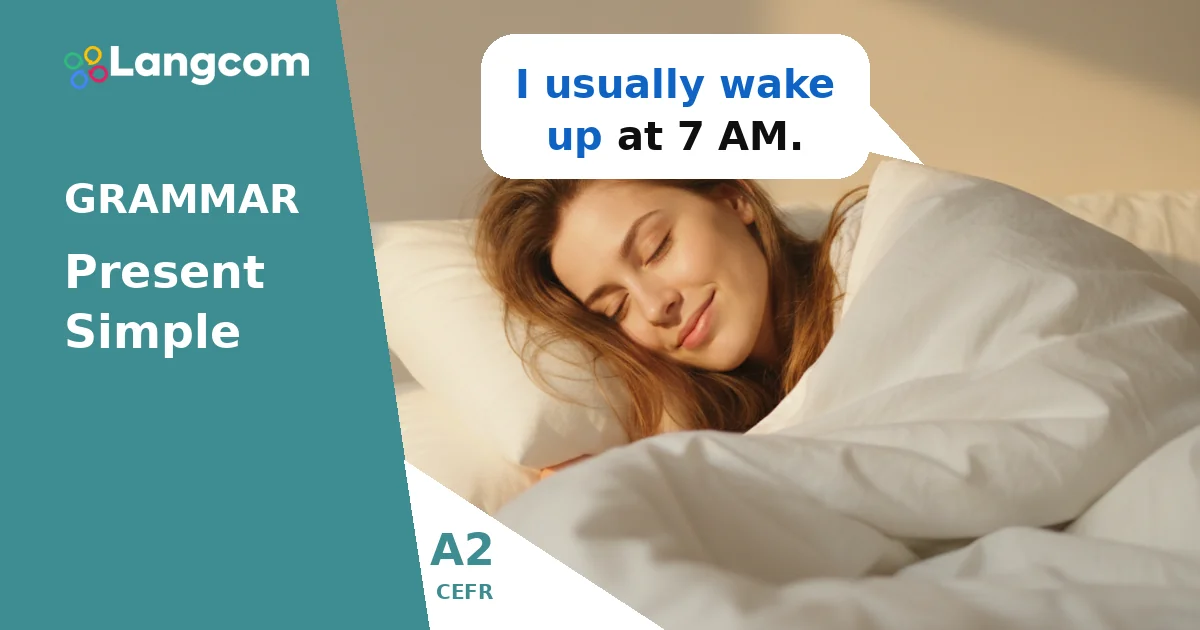
- Daily routines and habits: Actions you do regularly. I brush my teeth every morning.
- Facts and general truths: Things that are always true. Water boils at 100 degrees Celsius.
- Schedules and timetables: Fixed events, like public transport or cinema times. The train leaves at 8:00 AM.
- Opinions and feelings: What you think or feel. She likes chocolate.
✍️ ¿No sabes en qué nivel estás?
Realiza nuestra prueba de nivel gratuita y recibe comentarios personalizados de examinadores certificados por Cambridge.
Realice nuestra prueba de nivel GRATUITAHow Do We Form the Present Simple?
Forming the Present Simple is easy! The main verb changes only for he, she, y it.
Affirmative Sentences
- Para I, you, we, they: Use the base form of the verb. I eat breakfast.
- Para he, she, it: Add -s o -es to the base form. She eats breakfast.
Negative Sentences
Utilizamos do not (don't) or does not (doesn't) before the base form of the verb.
- Para I, you, we, they: do not + base verb. They don't like coffee.
- Para he, she, it: does not + base verb. He doesn't play tennis.
Questions
Utilizamos Do o Does at the beginning of the question, before the subject, and then the base form of the verb.
- Para I, you, we, they: Do + subject + base verb? Do you live here?
- Para he, she, it: Does + subject + base verb? Does she speak Spanish?
When Do We Add -es to Verbs?
Para he, she, y it, we usually add -s. But sometimes we add -es.
- If the verb ends in -ch, -sh, -s, -x, o -z, add -es. Examples: watch → watches, wash → washes, kiss → kisses, fix → fixes.
- If the verb ends in -o, add -es. Example: go → goes, do → does.
- If the verb ends in a consonant + -y, change -y to -ies. Example: study → studies, fly → flies.
- If the verb ends in a vowel + -y, just add -s. Example: play → plays.
Using Adverbs of Frequency
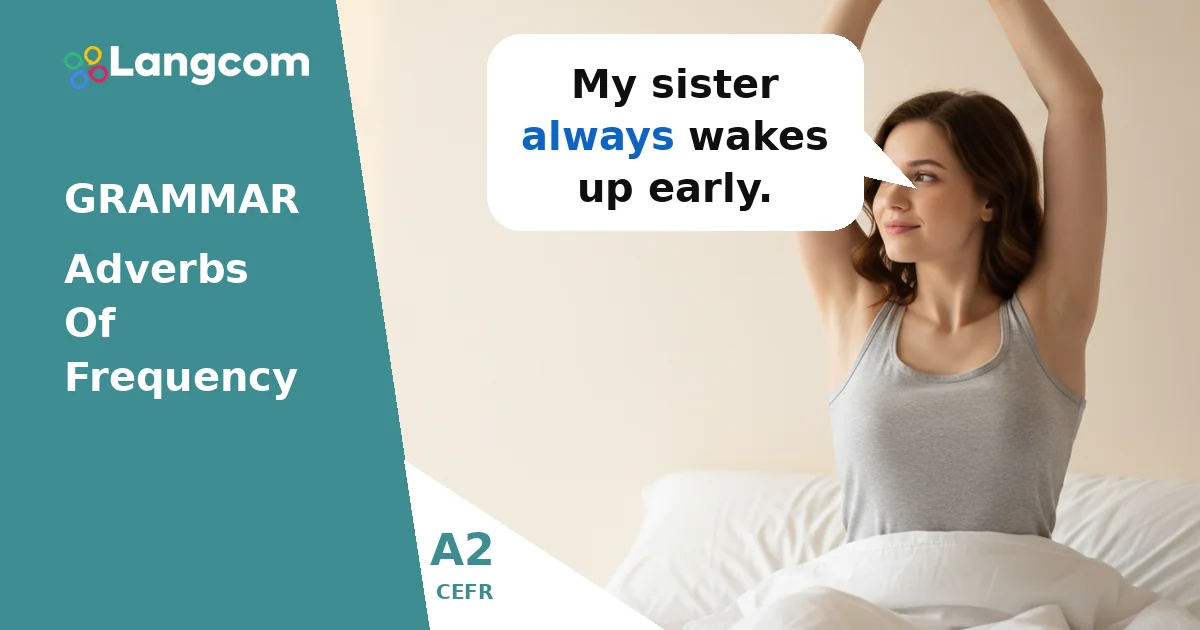
We often use adverbs of frequency with the Present Simple to say how often something happens.
- Common adverbs: always, usually, often, sometimes, hardly ever, never.
- Place them before the main verb: I always drink tea in the morning.
- Place them after the verb to be: She is always happy.
| Subject | Affirmative | Negative | Pregunta |
|---|---|---|---|
| I | I work. | I don't work. | Do I work? |
| You | You work. | You don't work. | Do you work? |
| He | He works. | He doesn't work. | Does he work? |
| She | She works. | She doesn't work. | Does she work? |
| It | It works. | It doesn't work. | Does it work? |
| We | We work. | We don't work. | Do we work? |
| They | They work. | They don't work. | Do they work? |
Ejemplos
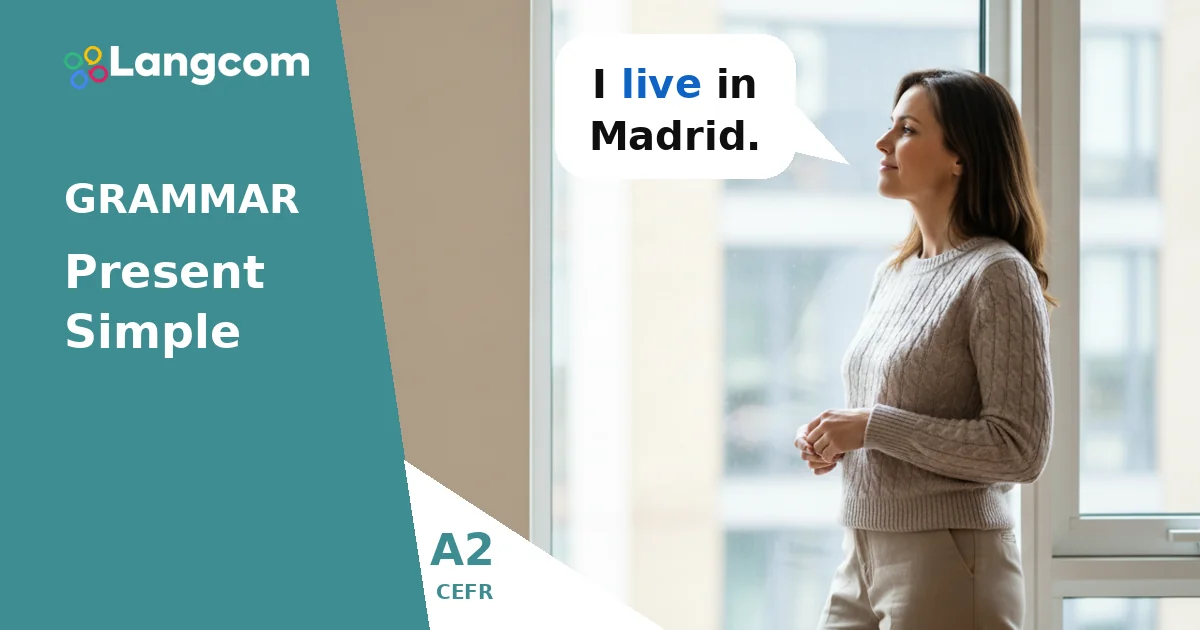
- I live in Madrid.
- They play football on Saturdays.
- He works in an office.
- She doesn't like cold weather.
- We don't watch TV very often.
- Does your brother speak French?
- Do you usually go to bed late?
- The sun sets in the west.
- My sister studies English every day.
- He never eats meat.
Práctica
¿Estás listo para obtener tu certificado?
El curso Langcom prepara a los alumnos para los exámenes de Cambridge, IELTS, TOEFL, DELE, SIELE y Michigan.
Empieza a utilizar LangcomErrores habituales de los hispanohablantes
A common mistake for Spanish speakers is forgetting the -s for he, she, y it. In Spanish, verb endings change for all persons, but in English, only the third person singular has a special ending in the Present Simple.
- Incorrecto: He work at a bank.
- Correcto: He works at a bank.
Another error is using do o does with the main verb in affirmative sentences, or not using them correctly in negatives and questions.
- Incorrecto: I do like coffee. (Unless for emphasis)
- Correcto: I like coffee.
- Incorrecto: She no like tea.
- Correcto: She doesn't like tea.
Preguntas más frecuentes
What is the difference between 'do' and 'does' in the Present Simple?
Utilizamos do for I, you, we, y they in questions and negative sentences. For example, Do you like pizza? Utilizamos does for he, she, y it. Por ejemplo, Does she live in London?
Can I use the Present Simple for future events?
Yes, you can use the Present Simple for future events when talking about fixed schedules or timetables. For example, The bus arrives at 10 AM tomorrow. o My flight leaves at 3 PM.
How is the Present Simple used in the A2 Key exam?
In the A2 Key (KET) exam, you might use the Present Simple in the writing part to describe daily routines or people's habits. For example, you could write about your hobbies or a typical day. In the speaking part, you might answer questions about your family, your job, or what you do in your free time, all using the Present Simple.
What is the verb 'to be' like in the Present Simple?
The verb to be is special. It does not use do o does. Its forms are am (for I), is (for he, she, it), and are (for you, we, they). Por ejemplo, I am a student., She is happy., They are friends.

0 Comentarios