

What are Collocations?
Collocations are words that often go together. They are like word friends. For example, in English, we say heavy rain, not strong rain. Even if strong seems to make sense, heavy is the natural choice.
Learning collocations makes your English sound more natural and fluent. It also helps you understand native speakers better.
🎓 Learn English with the Blended method
Small groups · 24/7 AI Tutor · Cambridge preparation
Plans from $39 $79 per month
When to Use Make?
We often use make when we create, produce, or cause something to happen. Think of it as building or forming something new.
- For creating or producing:
make a cake
make a noise
make a plan - For decisions or choices:
make a decision
make a choice - For reactions or impressions:
make a good impression
make someone happy - For speaking or sounds:
make a speech
make a phone call
When to Use Do?
We generally use do for actions, tasks, or general activities. It often refers to performing an activity or completing a duty.
- For tasks or duties:
do homework
do the laundry
do the dishes - For general activities (often with something, anything, nothing):
do something
do nothing - For work or business:
do business
do a good job - For favors or harm:
do a favor
do harm
When to Use Give?
We use give when we transfer something to someone, offer something, or perform an action for another person.
- For offering or transferring:
give a gift
give money
give a hug - For communication or information:
give advice
give a presentation
give directions - For reactions or sounds:
give a laugh
give a shout - For medical or physical actions:
give an injection
give birth
| <span data-no-translation>Make</span> | <span data-no-translation>Do</span> | <span data-no-translation>Give</span> |
|---|---|---|
| make a decision | do homework | give advice |
| make a mistake | do the dishes | give a presentation |
| make a noise | do a favor | give a hug |
| make a plan | do business | give directions |
| make a phone call | do your best | give a shout |
| make an effort | do research | give a speech |
Examples
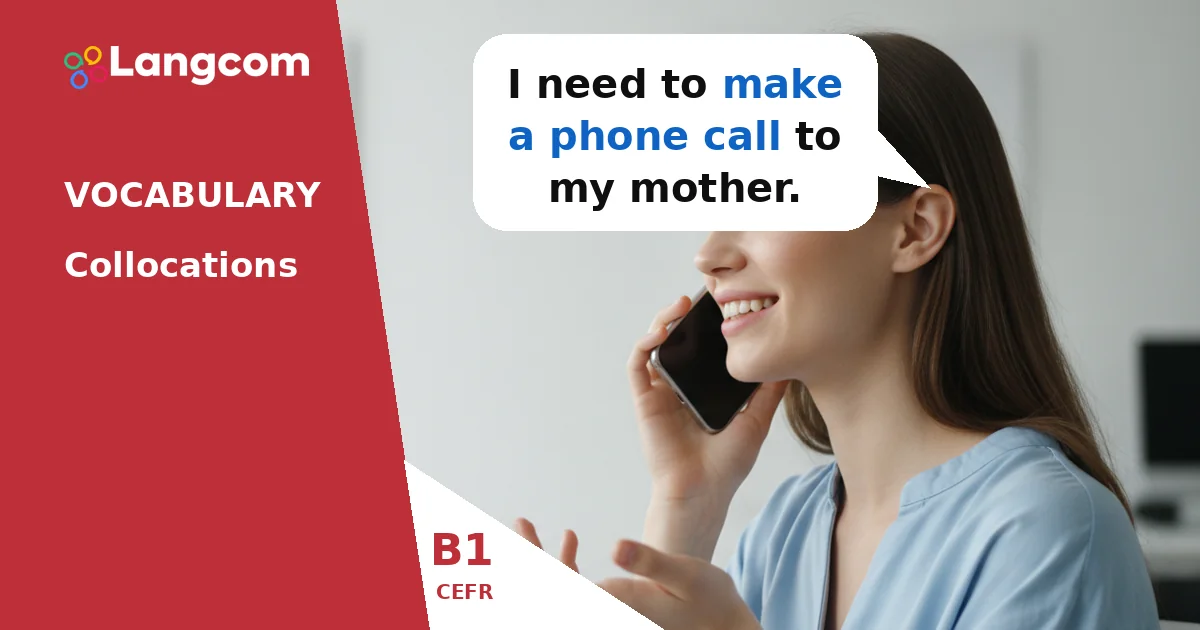
- I need to make a phone call to my mother.
- Please do your best on the exam.
- Can you give me some advice about my new job?
- She always makes a good impression on her clients.
- We decided to do some volunteer work this weekend.
- He gave a big smile when he saw his friends.
Practice
✍️ Not sure which level you are?
Take our free placement test and get personalized feedback from certified Cambridge examiners.
Take our FREE Placement TestCommon mistakes for Spanish speakers
Spanish speakers often confuse make and do because both can translate to 'hacer'. Also, give can be tricky when it means 'dar' but has specific collocations.
- Confusing make and do:
Incorrect: I need to do a decision.
Correct: I need to make a decision. (You create the decision.)Incorrect: Can you make me a favor?
Correct: Can you do me a favor? (You perform the favor.) - Confusing give with make or do:
Incorrect: I will make you some advice.
Correct: I will give you some advice. (You offer the advice.)Incorrect: She did a presentation.
Correct: She gave a presentation. (You deliver the presentation.)
Frequently asked questions
Why are collocations important in English?
Collocations help your English sound natural and fluent. Using the correct word combinations shows a higher level of English proficiency and helps you communicate more effectively, just like native speakers do.
Is there a simple rule to know when to use make or do?
Unfortunately, there isn't one simple rule that covers all cases. The best way to learn is by memorizing common collocations and practicing them. Think of make for creating/producing and do for performing tasks, but always check specific phrases.
How can I remember all these collocations?
Practice is key! Try reading English books, watching movies, and listening to podcasts. Pay attention to how native speakers use make, do, and give. You can also make flashcards or keep a notebook with new collocations and example sentences.
Can I use give for everything I offer or provide?
No, not always. While give means 'dar' in Spanish, English uses specific collocations. For example, you make a suggestion, not give a suggestion. Always learn the full collocation to be accurate.




0 Comments