

What Are Prepositions of Place?
Prepositions of place are words that tell us the position of something.
They answer the question “Where?”
- The book is on the table.
- The cat is under the bed.
🎓 Englisch lernen mit der Blended-Methode
Kleingruppen · KI-Tutor rund um die Uhr · Vorbereitung auf die Cambridge-Prüfungen
Pläne von $39 $79 pro Monat
How to Use In, On, and Under?
These are three very common prepositions.
- In: Use in for something inside a space or container.
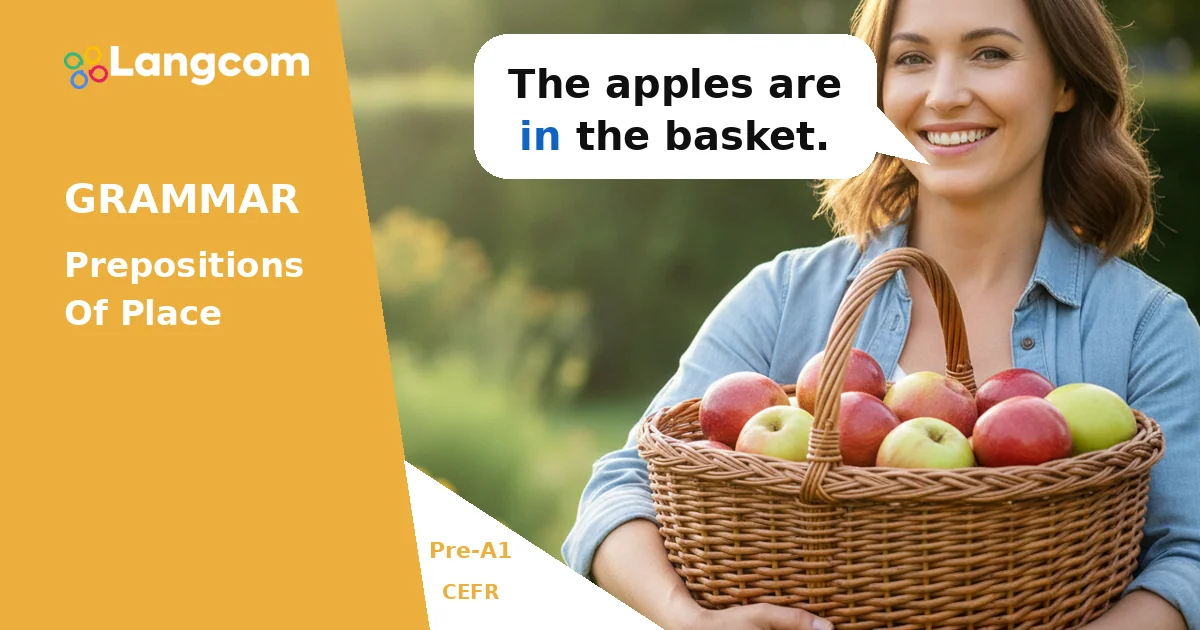
- The apples are in the basket.
- My keys are in my bag.
- On: Use on for something resting on a surface.
- The phone is on the desk.
- The picture is on the wall.
- Under: Use under for something below another object.
- The dog is under the table.
- My shoes are under the bed.
How to Use Next to, Behind, and In Front of?
These prepositions describe positions relative to another object.
- Next to: Use next to for something beside another object.
- The chair is next to the window.
- She sits next to her friend.
- Behind: Use behind for something at the back of another object.
- The car is behind the house.
- The teacher stands behind the desk.
- In front of: Use in front of for something at the forward side of another object.
- The bus stop is in front of the school.
- He is standing in front of the door.
Why Are Prepositions Important?
Prepositions help you give clear directions.
They make your descriptions accurate.
You can talk about where things are in your daily life.
| Preposition | Meaning |
|---|---|
| in | Inside a container or space |
| on | On a surface |
| under | Below something |
| next to | Beside something |
| behind | At the back of something |
| in front of | At the forward side of something |
Examples
- The apples are in the basket.
- My keys are in my bag.
- The phone is on the desk.
- The picture is on the wall.
- The dog is under the table.
- My shoes are under the bed.
- The chair is next to the window.
- She sits next to her friend.
- The car is behind the house.
- The teacher stands behind the desk.
- The bus stop is in front of the school.
- He is standing in front of the door.
Practice
💬 Benötigen Sie eine individuelle Beratung?
Als autorisiertes Cambridge-Vorbereitungszentrum können wir Ihnen helfen, den richtigen Kurs und die passende Zertifizierung zu finden. Chatten Sie noch heute mit unseren Beratern.
Chatten Sie mit einem Berater auf WhatsAppCommon mistakes for Spanish speakers
Spanish speakers often use “en” for both in und on. Remember they are different!
- Incorrect: The book is in the table. (This means inside the table.)
- Correct: The book is on the table. (This means on the surface of the table.)
Also, remember that in front of is three separate words, not one.
- Incorrect: The car is infrontof the house.
- Correct: The car is in front of the house.
Häufig gestellte Fragen
What is a preposition of place?
It is a word that tells you where something is located.
Can I use “in” and “on” for the same place?
No, they have different meanings. In means inside, and on means on a surface.
Are there other prepositions of place?
Yes, there are many more, but in, on, under, next to, behind, and in front of are excellent to start with for Pre-A1.



0 Kommentare