

Why are numbers 11-20 important in English?
Numbers 11 to 20 are basic but very useful. You need them for many daily situations.
- Talking about age: I am sixteen years old.
- Counting things: I have twelve books.
- Giving phone numbers: My number is five, five, five, one, three, seven, zero. (Here, thirteen und seventeen can be parts of a number).
- Saying prices: This costs fifteen dollars.
🎓 Englisch lernen mit der Blended-Methode
Kleingruppen · KI-Tutor rund um die Uhr · Vorbereitung auf die Cambridge-Prüfungen
Pläne von $39 $79 pro Monat
What are the English numbers from 11 to 20?
Here are the numbers from 11 to 20. Pay attention to how they look and sound.
- 11: eleven
- 12: twelve
- 13: thirteen
- 14: fourteen
- 15: fifteen
- 16: sixteen
- 17: seventeen
- 18: eighteen
- 19: nineteen
- 20: twenty
How can I use numbers 11-20 in sentences?
Using numbers in sentences is simple. Just put the number before the noun it describes. Look at these examples:
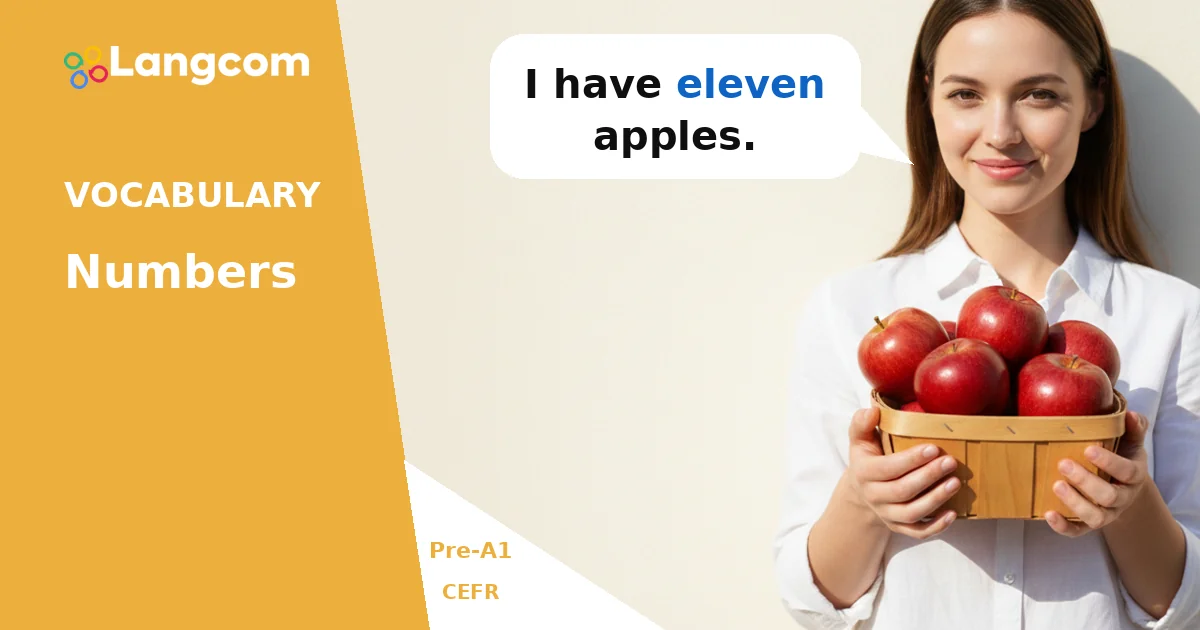
- I have eleven apples.
- She is twelve years old.
- There are thirteen students in the class.
- He has fourteen books at home.
- We saw fifteen birds in the park.
- My sister is sixteen.
- I need seventeen pencils for school.
- There are eighteen chairs in the room.
- He bought nineteen candies.
- I have twenty friends.
| Number | English Word |
|---|---|
| 11 | eleven |
| 12 | twelve |
| 13 | thirteen |
| 14 | fourteen |
| 15 | fifteen |
| 16 | sixteen |
| 17 | seventeen |
| 18 | eighteen |
| 19 | nineteen |
| 20 | twenty |
Examples
- I have eleven apples.
- She is twelve years old.
- There are thirteen students.
- He has fourteen books.
- We saw fifteen birds.
- My sister is sixteen.
- I need seventeen pencils.
- There are eighteen chairs.
- He bought nineteen candies.
- I have twenty friends.
Practice
💬 Benötigen Sie eine individuelle Beratung?
Als autorisiertes Cambridge-Vorbereitungszentrum können wir Ihnen helfen, den richtigen Kurs und die passende Zertifizierung zu finden. Chatten Sie noch heute mit unseren Beratern.
Chatten Sie mit einem Berater auf WhatsAppCommon mistakes for Spanish speakers
A common mistake for Spanish speakers is trying to translate numbers directly. For example, saying ten and one instead of eleven. Remember that eleven, twelve, and twenty are unique words in English.
Another mistake is confusing the -teen sound (like in thirteen) with the -ty sound (like in thirty). For numbers 13 to 19, always use -teen. Pay attention to the stress in words like thirteen (stress on ‘teen’) versus thirty (stress on ‘thir’).
Häufig gestellte Fragen
Why are ‘eleven’ and ‘twelve’ special?
Numbers eleven und twelve are special because they do not follow the -teen pattern. They have their own unique names, just like one to ten.
How can I remember the ‘teen’ numbers?
Numbers from thirteen to nineteen all end with -teen. You can think of it like ‘ten plus three’ becomes thirteen. This pattern helps you remember them.
Are numbers 11-20 used often in English?
Yes, numbers 11 to 20 are used very often in daily English. You need them for counting, telling age, giving phone numbers, and many other common situations.


0 Kommentare