

What is Sentence Stress?
English is a ‘stress-timed’ language. This means some words in a sentence are stronger and longer than others. This is called sentence stress.
- When you speak, you make some words louder, longer, and with a higher pitch.
- Other words are shorter and quieter.
- This rhythm helps English sound natural and clear to listeners.
Where Does the Main Stress Go in Polite Requests?
When you make a polite request in English, the main stress usually falls on the main verb. This is the most important action word in your request.
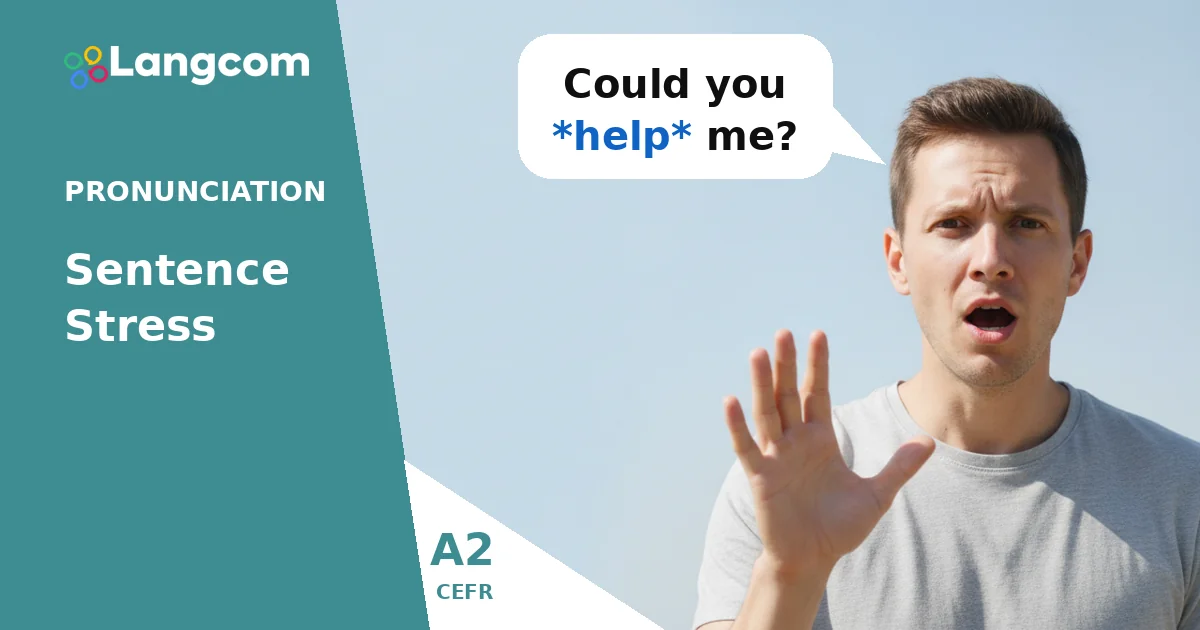
- For example, in Could you *help* me?, the main verb is help.
- In Would you mind *showing* me?, the main verb is showing.
- 诸如……之类的词 could, can, would, do, , 和 you are usually unstressed in these requests. They are shorter and quieter.
What About Intonation in Polite Requests?
Intonation is the rise and fall of your voice when you speak. For polite requests, the intonation often goes down at the end of the sentence.
- A falling tone makes your request sound softer and more polite.
- It is different from many ‘yes/no’ questions, where the intonation often rises at the end.
- For example, listen to how your voice goes down at the end of Can you *help* me? to sound more natural and polite.
Why is Sentence Stress Important for A2 Learners?
Learning sentence stress helps you communicate better in English.
- Clarity: It helps people understand your main message easily.
- Natural Sound: Your English will sound more like a native speaker.
- Understanding: You will also understand native speakers better when they use stress.
| Request Type | Main Stress Example |
|---|---|
| Asking for help | Can you *help* me? |
| Asking for a favor | Would you mind *closing* the door? |
| Asking for information/direction | Could you *show* me the way? |
| Making a suggestion | Do you want to *eat* now? |
示例
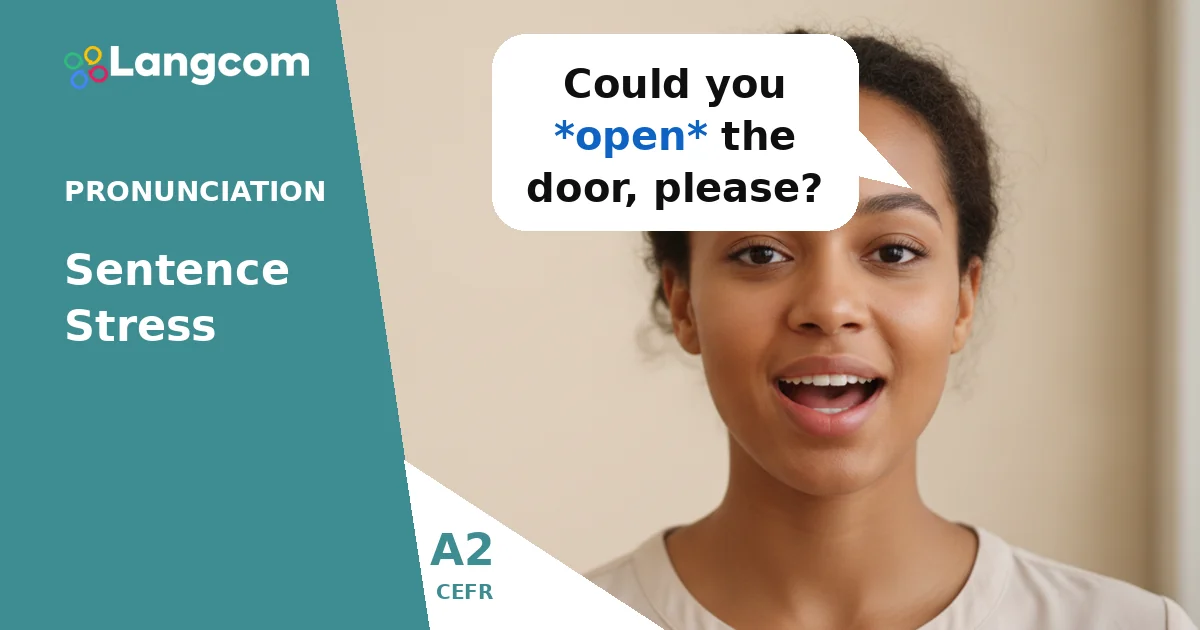
- Could you *open* the door, please?
- Can you *pass* me the salt?
- Would you mind *waiting* for a moment?
- Do you mind *moving* your bag?
- I need you to *listen* carefully.
练习
西班牙语母语者常犯的错误
Many Spanish speakers put stress on almost every word in a sentence. However, English uses stress on specific words.
- Mistake: Stressing auxiliary verbs or pronouns too much. For example, saying *Could* *you* *help* *me*? with equal stress on every word.
- Correction: Focus the main stress on the main verb: Could you *help* me?
- Mistake: Using rising intonation for all questions, including polite requests.
- Correction: Remember that polite requests often have a falling intonation at the end to sound softer: Would you mind *closing* the window? (with a falling tone).
常见问题
What is the main purpose of sentence stress?
The main purpose of sentence stress is to make your speech clear and natural. It helps listeners understand the most important words in your sentence.
Does stress change the meaning of a sentence?
Yes, sometimes. Changing the stressed word can change what you want to emphasize. For example, I *love* coffee (you really like it) versus *I* love coffee (not someone else).
Why is a falling tone used for polite requests?
A falling tone at the end of a polite request, like Could you help me?, can make your request sound softer, more polite, and less demanding. It’s a common pattern for these types of questions in English.


0 条评论