

What are common places in a town?
Every town has many different places. We go to these places for different reasons. Learning their names helps you describe your town.
- A park is a green place with trees and grass. You can play or relax there.
- A school is where children learn.
- A shop or store is where you buy things.
- A supermarket is a big shop for food.
- A hospital is where sick people go for help.
- A bank is where you keep your money.
- A restaurant is where you eat food.
- A cafe is where you drink coffee or tea.
- A library is a place with many books. You can read books there.
- A bus stop is where you wait for the bus.
- A train station is where you take a train.
🎓 Apprenez l'anglais grâce à la méthode mixte
Petits groupes · Tuteur IA disponible 24 h/24, 7 j/7 · Préparation aux examens de Cambridge
Plans provenant de $39 $79 par mois
How do we use these words in sentences?
You can use these words to talk about where you go or what you see. Here are some simple examples.
- I go to the park.
- The school is big.
- I buy food at the supermarket.
- The bus stop is near my house.
- We eat at the restaurant.
Practice saying these sentences to help you remember the new words.
Where can you go in your town?
Think about your own town or city. What places do you visit often?
- Do you go to a park?
- Is there a supermarket near you?
- Do you like to eat at a restaurant or drink coffee at a cafe?
Try to say the names of these places in English. This helps you connect the new words to your daily life.
| Place | What you do there |
|---|---|
| Park | Play, walk, relax |
| School | Learn |
| Supermarket | Buy food |
| Restaurant | Eat food |
| Library | Read books, borrow books |
| Bank | Keep money, get money |
Exemples
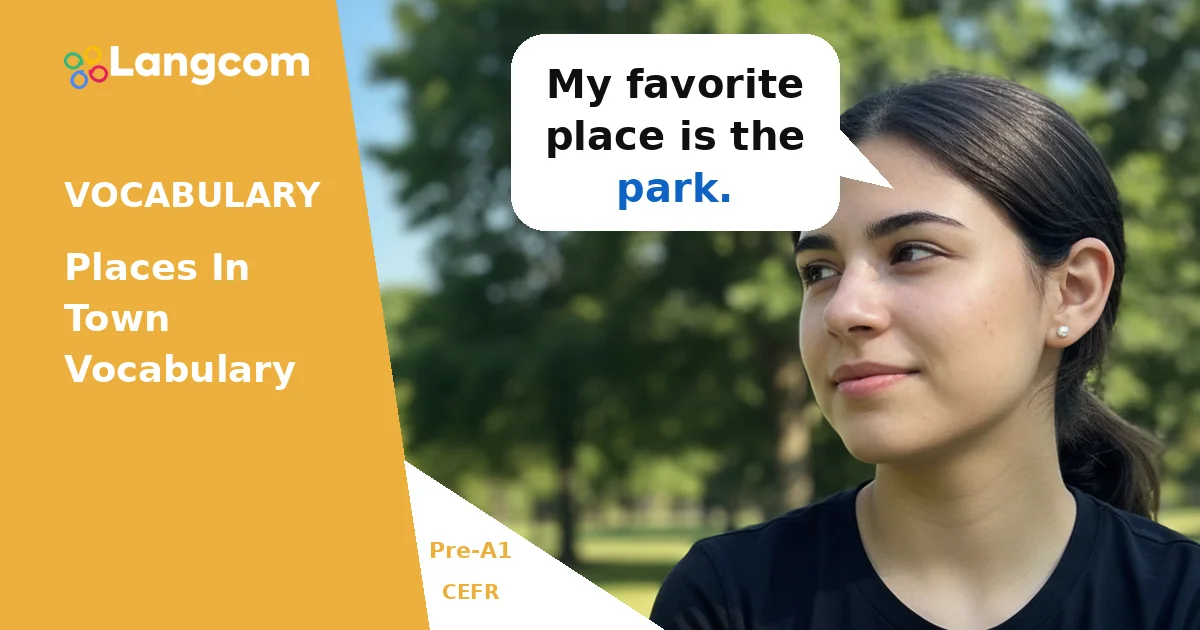
- My favorite place is the park.
- The school starts at 8 AM.
- I need to go to the shop.
- We buy groceries at the supermarket.
- The hospital is far from here.
- I need to go to the bank today.
- Let’s have dinner at the restaurant.
- She likes coffee from the cafe.
- I read books at the library.
- Wait for the bus at the bus stop.
- The train station is very busy.
Entraînement
💬 Vous avez besoin de conseils personnalisés ?
En tant que centre de préparation agréé par Cambridge, nous pouvons vous aider à choisir la formation et la certification qui vous conviennent. Discutez-en dès aujourd'hui avec nos conseillers.
Discutez avec un conseiller sur WhatsAppErreurs courantes chez les hispanophones
Spanish speakers sometimes confuse similar words:
- Library vs. Bookshop: In Spanish, ‘librería’ means a place to buy books. In English, a bookshop is where you buy books. A library is where you borrow books for free.
- Shop vs. Store: These words are very similar. Shop is common in British English, and store is common in American English. Both mean a place to buy things. For example, a clothes shop or a clothes store.
- Chemist vs. Pharmacy: Both words mean ‘farmacia’. Chemist is more common in British English, and pharmacy is more common in American English.
Questions fréquemment posées
Why is it important to learn names of places?
Learning names of places helps you talk about your daily life. You can say where you go, where you live, or ask for directions. It makes simple conversations much easier in English.
What is the difference between a ‘shop’ and a ‘store’?
Shop et store mean the same thing: a place where you buy things. Shop is often used in British English, and store is often used in American English. You can use either word.
How can I remember new vocabulary?
To remember new words like park or supermarket, try to use them often. Say them aloud, write them down, or point to the places in your town and say their English names. You can also draw pictures for each word.




0 commentaire