
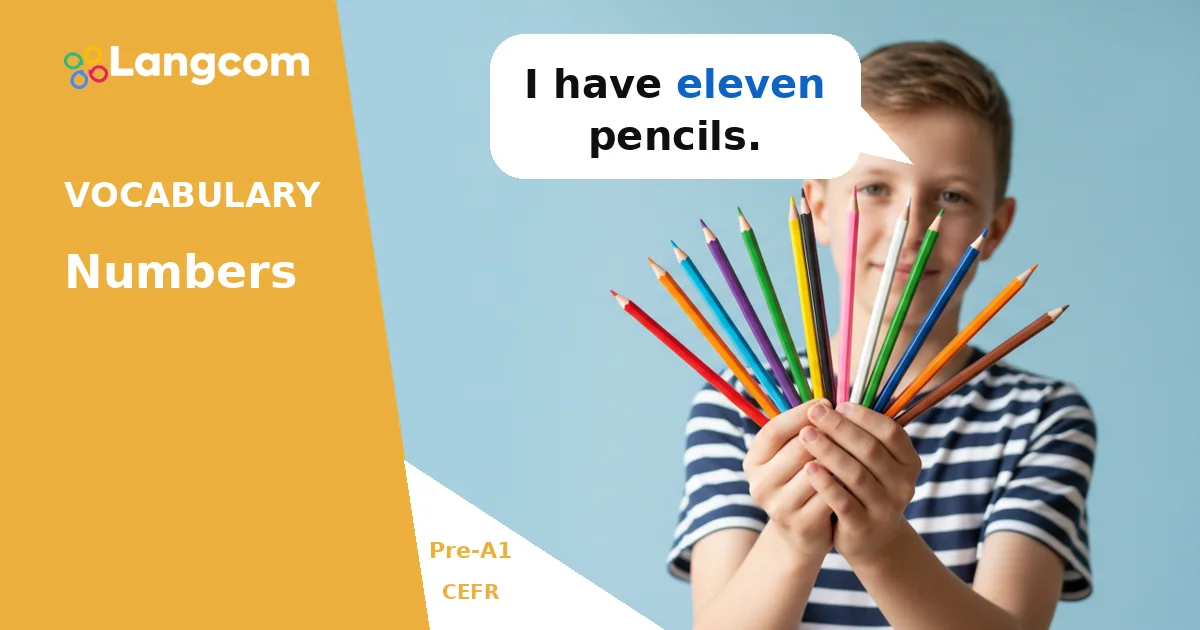

Why are numbers 11-20 important in English?
Numbers 11 to 20 are very useful in daily life. You use them all the time.
- To say your age or someone else’s age: I am sixteen.
- To talk about quantities: There are twelve apples.
- To give phone numbers or addresses: My number is five-five-five-one-four-eight-eleven.
- To talk about time or dates: The meeting is at nineteen o’clock.
🎓 Apprenez l'anglais grâce à la méthode mixte
Petits groupes · Tuteur IA disponible 24 h/24, 7 j/7 · Préparation aux examens de Cambridge
Plans provenant de $39 $79 par mois
How do you say numbers 11-20 in English?
Here are the numbers from 11 to 20. Listen carefully and repeat them.
- 11: eleven
- 12: twelve
- 13: thirteen
- 14: fourteen
- 15: fifteen
- 16: sixteen
- 17: seventeen
- 18: eighteen
- 19: nineteen
- 20: twenty
Are there any special rules for numbers 11-20?
Yes, there are a few things to remember about these numbers.
- Eleven et twelve are special. They do not end in -teen.
- Numbers from thirteen to nineteen all end with -teen. This sound is important!
- The number twenty is also special. It does not end in -teen.
- Pay attention to the spelling. For example, fifteen is not fiveteen.
| Nombre | Word |
|---|---|
| 11 | eleven |
| 12 | twelve |
| 13 | thirteen |
| 14 | fourteen |
| 15 | fifteen |
| 16 | sixteen |
| 17 | seventeen |
| 18 | eighteen |
| 19 | nineteen |
| 20 | twenty |
Exemples
- I have eleven pencils.
- My brother is twelve years old.
- There are thirteen chairs in the room.
- She bought fourteen apples.
- We saw fifteen birds.
- He has sixteen books.
- There are seventeen days left.
- I need eighteen eggs.
- She lives at number nineteen.
- There are twenty students in the class.
Entraînement
💬 Vous avez besoin de conseils personnalisés ?
En tant que centre de préparation agréé par Cambridge, nous pouvons vous aider à choisir la formation et la certification qui vous conviennent. Discutez-en dès aujourd'hui avec nos conseillers.
Discutez avec un conseiller sur WhatsAppErreurs courantes chez les hispanophones
Spanish speakers sometimes make small mistakes with these numbers. Here are some common ones:
- Confusing -teen et -ty: It is easy to confuse numbers like thirteen (13) and thirty (30). Listen carefully to the end sound. Thirteen has a long ‘ee’ sound at the end. Thirty has a short ‘ee’ sound.
- Pronouncing V dans Twelve: Make sure to pronounce the v sound clearly in twelve. It is not twel.
- Spelling Fifteen: Remember it is fifteen, not fiveteen.
Questions fréquemment posées
How can I remember these numbers easily?
Practice is key! Say the numbers aloud many times. Write them down. Try to count objects around you, like eleven books or fifteen pens. Listen to English songs or videos that use numbers.
Are numbers 11-20 used often?
Yes, very often! You use them for age, counting things, telling time, and many other daily situations. They are fundamental for basic communication.
Is the pronunciation of -teen important?
Yes, it is very important! The -teen sound helps people know if you mean 13 (thirteen) or 30 (thirty). Make sure to stress the -teen part.

0 commentaire