

What do ‘There is’ and ‘There are’ mean?
In English, we use there is y there are to say that something exists. It is similar to “hay” in Spanish.
We use these phrases to describe places, like your room, a city, or a picture.
- Use there is for one thing (singular).
- Use there are for two or more things (plural).
🎓 Aprende inglés con el método mixto
Grupos reducidos · Tutor de IA disponible las 24 horas del día, los 7 días de la semana · Preparación para los exámenes de Cambridge
Planes de $39 $79 al mes
How do we use ‘There is’ for one thing?
Utilizamos there is when we talk about only one noun. We often use ‘a’, ‘an’, or ‘one’ before the noun.
- Positive: There is a book on the table.
- Negative: There isn’t a book on the table. (We use isn’t for is not)
- Question: Is there a book on the table?
You can also use a contraction for there is in positive sentences: There’s.
- There’s a pen in my bag.
How do we use ‘There are’ for many things?
Utilizamos there are when we talk about two or more nouns. We often use numbers, ‘some’, or ‘any’ before the noun.
- Positive: There are two chairs in the room.
- Negative: There aren’t any chairs in the room. (We use aren’t for are not)
- Question: Are there any chairs in the room?
We do not use a contraction for there are in positive sentences.
When do we use ‘some’ and ‘any’ with ‘There are’?
When we talk about plural nouns, we often use some o any.
- Some: Use some in positive sentences. It means an unspecified number (more than one).
- There are some apples in the basket.
- Any: Use any in negative sentences and questions.
- There aren’t any apples in the basket.
- Are there any apples in the basket?
| Singular (one thing) | Plural (two or more things) | |
|---|---|---|
| Positive | There is a cat. | There are two dogs. |
| Negative | There isn’t a cat. | There aren’t any dogs. |
| Question | Is there a cat? | Are there any dogs? |
Ejemplos
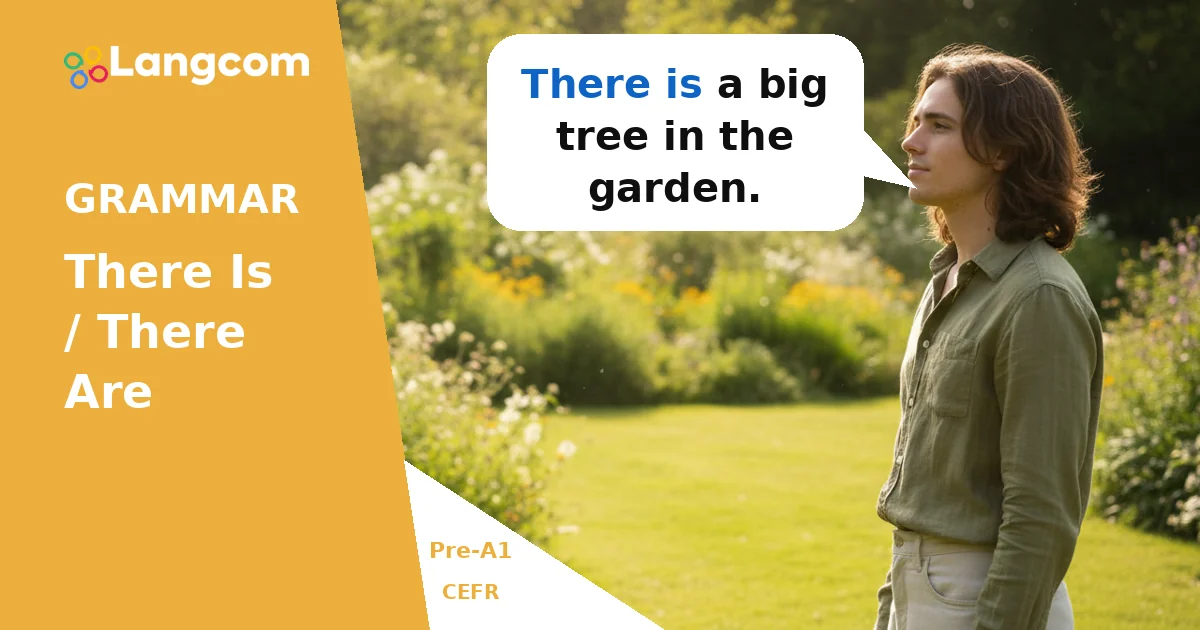
- There is a big tree in the garden.
- Is there a supermarket near here?
- No, there isn’t a supermarket.
- There are three books on my desk.
- Are there any students in the classroom?
- Yes, there are some students.
- There aren’t any pens in my pencil case.
- There’s a cat sleeping on the sofa.
Práctica
💬 ¿Necesitas asesoramiento personalizado?
Como centro autorizado de preparación para los exámenes de Cambridge, podemos orientarte para que elijas el curso y la certificación más adecuados. Habla hoy mismo con nuestros asesores.
Chatea con un asesor por WhatsAppErrores habituales de los hispanohablantes
Spanish speakers sometimes make these mistakes:
- Uso de It is o They are instead of There is o There are:
Incorrecto: It is a park in my city.
Correcto: There is a park in my city.
Incorrecto: They are many cars on the street.
Correcto: There are many cars on the street. - Uso de is for plural nouns:
Incorrecto: There is two windows.
Correcto: There are two windows. - Forgetting ‘a’ or ‘an’ with singular nouns:
Incorrecto: There is chair in the room.
Correcto: There is a chair in the room.
Preguntas más frecuentes
What is the main difference between there is and there are?
The main difference is number. We use there is for one thing (singular) and there are for two or more things (plural).
Can I use contractions with there is and there are?
Yes, you can use there’s for there is in positive sentences. For negative sentences, use there isn’t y there aren’t. We do not use a contraction for there are in positive sentences.
Why do we use ‘some’ and ‘any’ with ‘there are’?
Utilizamos some in positive sentences with plural nouns (e.g., There are some books.). We use any in negative sentences and questions with plural nouns (e.g., There aren’t any books. o Are there any books?).
Is there is/are similar to ‘hay’ in Spanish?
Sí, there is y there are both translate to “hay” in Spanish. The choice between is y are depends on whether the noun is singular or plural in English.




0 Comentarios