
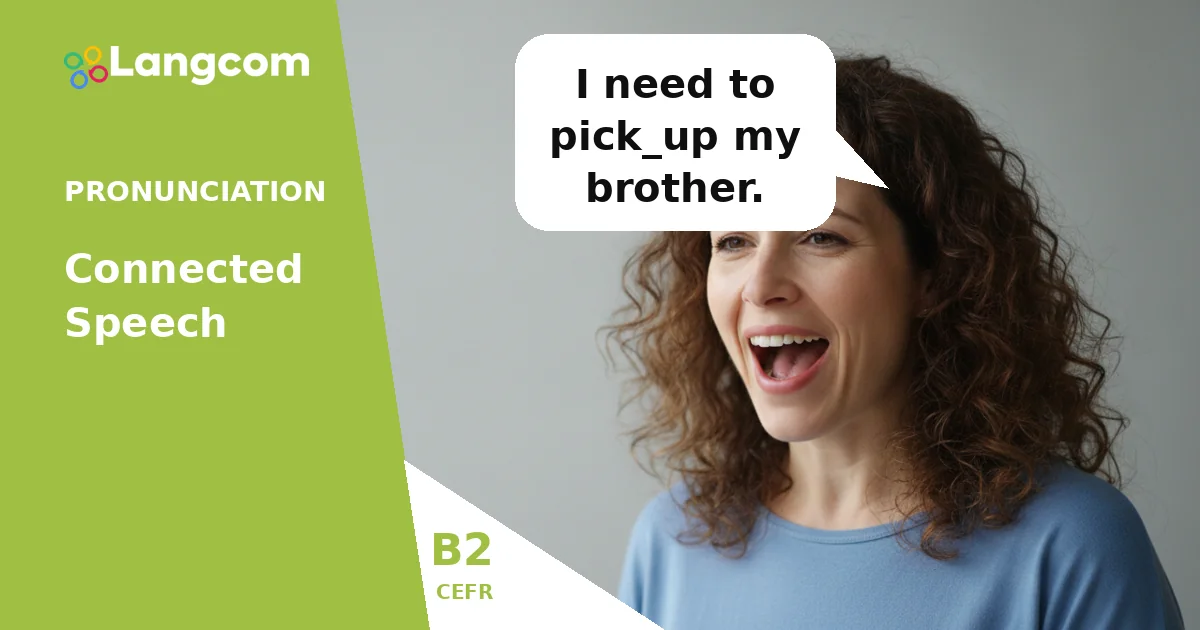

What is Connected Speech?
In everyday English, we do not pronounce each word separately. Instead, words often blend together, creating a continuous flow of sound.
This blending is called connected speech. It helps speakers communicate more quickly and smoothly.
✍️ ¿No sabes en qué nivel estás?
Realiza nuestra prueba de nivel gratuita y recibe comentarios personalizados de examinadores certificados por Cambridge.
Realice nuestra prueba de nivel GRATUITAHow Does Linking Work?
Linking happens when a word ends with a consonant sound and the next word begins with a vowel sound.
The final consonant sound of the first word joins with the initial vowel sound of the second word. This creates a smooth transition between the words.
- Consonant + Vowel: The consonant sound moves to the next word.
- Ejemplo: an apple sounds like a-napple.
- Ejemplo: what is it sounds like wha-ti-zit.
What is Intrusion in Pronunciation?
Intrusion occurs when two vowel sounds meet, one at the end of a word and one at the beginning of the next word.
To avoid a pause or a ‘gap’ between the vowels, a small, extra consonant sound is added. These sounds are usually /j/, /w/, or /r/.
- Intrusive /j/: This sound is added after vowel sounds like /iː/, /eɪ/, /aɪ/, /ɔɪ/.
- Intrusive /w/: This sound is added after vowel sounds like /uː/, /oʊ/, /aʊ/.
- Intrusive /r/: This sound is added by non-rhotic speakers (like in British English) when a word ending in /ə/ or /ɑː/ is followed by a vowel. This is sometimes called ‘linking /r/’ if the ‘r’ is in the spelling, but ‘intrusive /r/’ if it’s not.
Why are Linking and Intrusion Important for B2 Learners?
Mastering these features of connected speech is crucial for B2 learners.
- Improved Listening: You will understand native speakers better, especially when they speak quickly.
- More Natural Pronunciation: Your own speech will sound more fluent and less ‘choppy’.
- Enhanced Fluency: It helps you speak more smoothly and confidently.
| Ending Vowel Sound(s) | Intrusive Sound | Example |
|---|---|---|
| /iː/, /eɪ/, /aɪ/, /ɔɪ/ | /j/ | she_is, play_it, I_am |
| /uː/, /oʊ/, /aʊ/ | /w/ | do_it, go_away, how_are you |
| /ə/, /ɑː/ (non-rhotic accents) | /r/ | idea_of, draw_it |
Ejemplos
- I need to pick_up my brother.
- It’s an_old_idea.
- She_is always happy.
- Go_away now!
- How_are you doing?
- The car_is red. (Intrusive /r/ in non-rhotic accents)
- I_am going home.
- Do_it again.
Práctica
¿Estás listo para obtener tu certificado?
El curso Langcom prepara a los alumnos para los exámenes de Cambridge, IELTS, TOEFL, DELE, SIELE y Michigan.
Empieza a utilizar LangcomErrores habituales de los hispanohablantes
Spanish speakers often pronounce each word distinctly, even when words should link or intrude. For example, saying I am with a clear break between I y am, instead of the more natural I-yam.
Another common error is not linking a final consonant to an initial vowel. For instance, pronouncing take it as two separate words instead of the linked ta-kit. This makes speech sound less natural and can sometimes make it harder for native speakers to follow.
Preguntas más frecuentes
Is linking the same as intrusion?
No, they are different types of connected speech. Linking is when a final consonant sound joins an initial vowel sound, like in black_ink. Intrusion is when an extra consonant sound (/j/, /w/, or /r/) is added between two vowel sounds, like in go_away.
Do I always have to use linking and intrusion?
For natural, fluent English, especially at B2 level and above, using linking and intrusion is highly recommended. It helps you sound more like a native speaker and improves your listening comprehension.
How can I practice linking and intrusion?
Listen carefully to native speakers in films, podcasts, and conversations. Try to imitate how they connect words. You can also record yourself speaking and compare it to a native speaker’s pronunciation of the same phrases. Focus on phrases like as_if o new_ideas.


0 Comentarios