
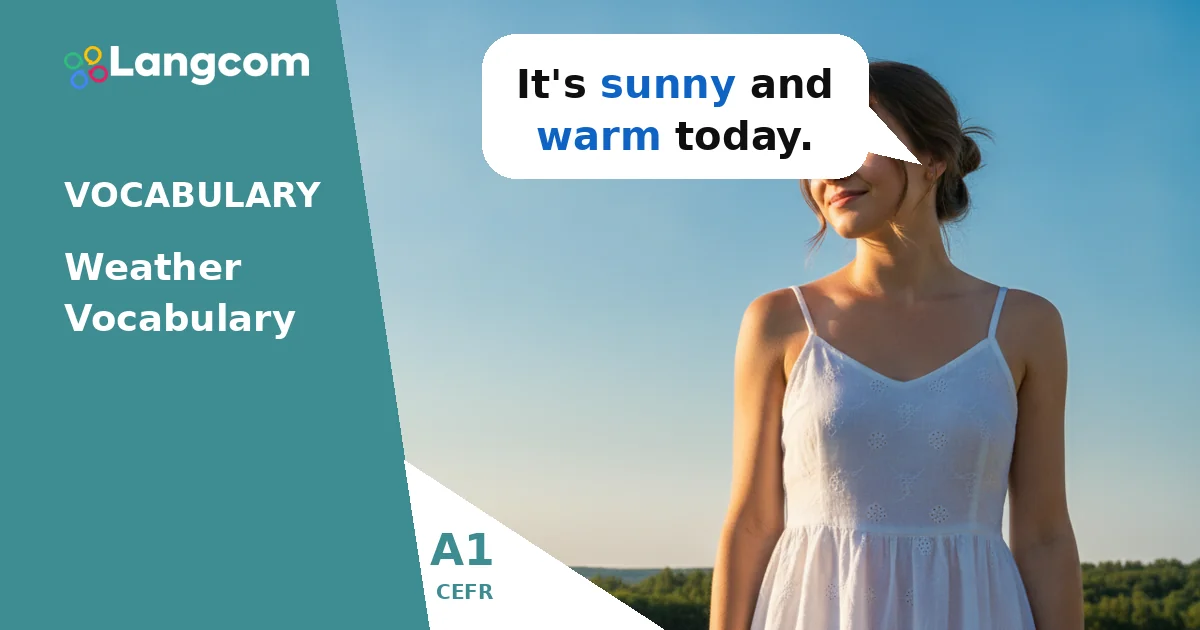

How Do We Talk About the Weather in English?
When we talk about the weather, we usually use the word It and the verb to be.
We then add an adjective to describe the weather.
- It’s hot.
- It’s cold.
- It’s sunny.
🎓 Aprende inglés con el método mixto
Grupos reducidos · Tutor de IA disponible las 24 horas del día, los 7 días de la semana · Preparación para los exámenes de Cambridge
Planes de $39 $79 al mes
What Are Common Weather Words?
Here are some basic words to describe the weather:
- Sunny: When the sun is shining.
- Cloudy: When there are many clouds in the sky.
- Rainy: When it is raining.
- Windy: When there is a lot of wind.
- Snowy: When it is snowing.
- Hot: When the temperature is high.
- Warm: When the temperature is pleasant, not too hot, not too cold.
- Cold: When the temperature is low.
- Cool: When the temperature is a little cold, but comfortable.
How to Ask and Answer About the Weather?
To ask about the weather, we use a special question.
- Question: What’s the weather like?
- Answer: It’s sunny. o It’s cold.
You can also ask about the weather in a specific place.
- Question: What’s the weather like in London?
- Answer: It’s rainy in London today.
What Are Weather Nouns and Adjectives?
Many weather words have a noun form and an adjective form. Nouns are things, and adjectives describe things.
- Sun (noun) becomes sunny (adjective).
- Rain (noun) becomes rainy (adjective).
- Cloud (noun) becomes cloudy (adjective).
- Wind (noun) becomes windy (adjective).
- Snow (noun) becomes snowy (adjective).
We use the adjective with It’s to describe the weather.
| Noun (The thing) | Adjective (How it is) |
|---|---|
| sun | sunny |
| rain | rainy |
| cloud | cloudy |
| wind | windy |
| snow | snowy |
Ejemplos
- It’s sunny and warm today.
- I don’t like rainy weather.
- Look! It’s very cloudy. Maybe it will rain.
- It’s windy, so wear a jacket.
- In winter, it’s often snowy and cold.
- What’s the weather like in your city?
Práctica
💬 ¿Necesitas asesoramiento personalizado?
Como centro autorizado de preparación para los exámenes de Cambridge, podemos orientarte para que elijas el curso y la certificación más adecuados. Habla hoy mismo con nuestros asesores.
Chatea con un asesor por WhatsAppErrores habituales de los hispanohablantes
Spanish speakers sometimes make these mistakes:
- Using ‘make’ instead of ‘be’: In Spanish, you say “hace calor” (it makes heat). In English, you must say It’s hot.
✗ It makes hot.
✓ It’s hot. - Using the noun instead of the adjective: Remember to use the adjective to describe the weather.
✗ It’s sun.
✓ It’s sunny. - Direct translation of ‘mucho’: For weather, we use very with adjectives or a lot of with nouns.
✗ It’s much cold.
✓ It’s very cold.
Preguntas más frecuentes
How do I ask about the weather in English?
You can ask: What’s the weather like? o How’s the weather?
What is the difference between ‘sun’ and ‘sunny’?
Sun is a noun (a thing), like the big star in the sky. Sunny is an adjective (a descriptive word), meaning ‘full of sun’ or ‘bright with sun’.
Can I say ‘It’s a lot of sun’?
No, it’s better to say It’s very sunny. You can say There’s a lot of sun, pero It’s very sunny is more common for describing the weather.




0 Comentarios