

What is the Present Continuous?
The Present Continuous tense describes actions that are happening at the exact moment of speaking. It tells us what is in progress right now.
We form it with the verb to be (am, is, are) and the -ing form of the main verb.
🎓 Englisch lernen mit der Blended-Methode
Kleingruppen · KI-Tutor rund um die Uhr · Vorbereitung auf die Cambridge-Prüfungen
Pläne von $39 $79 pro Monat
How do you make Present Continuous negative?
To make a Present Continuous sentence negative, you add the word not after am, is, oder are.
The structure is: Subject + am/is/are + not + verb-ing.
- I am not working.
- You are not listening.
- He is not reading.
- She is not sleeping.
- It is not raining.
- We are not eating.
- They are not watching TV.
We often use contractions in spoken English and informal writing. These make sentences shorter and sound more natural.
- I’m not working.
- You aren’t listening.
- He isn’t reading.
- She isn’t sleeping.
- It isn’t raining.
- We aren’t eating.
- They aren’t watching TV.
How do you ask questions with Present Continuous?
To ask a Yes/No question in the Present Continuous, you change the order of the subject and the verb to be.
The structure is: Am/Is/Are + Subject + verb-ing?
- Am I talking too fast?
- Are you studying English?
- Is he playing football?
- Is she cooking dinner?
- Is it snowing outside?
- Are we going to the park?
- Are they waiting for us?
For short answers, we use Yes/No + subject + am/is/are (or aren’t/isn’t for negative).
- Are you studying English? Yes, I am. / No, I’m not.
- Is he playing football? Yes, he is. / No, he isn’t.
- Are they waiting for us? Yes, they are. / No, they aren’t.
What about ‘Wh-‘ questions?
You can also ask questions using question words like What, Where, Why, oder Who. These questions ask for specific information, not just a ‘yes’ or ‘no’.
The structure is: Wh- word + am/is/are + Subject + verb-ing?
- What are you doing?
- Where is she going?
- Why are they laughing?
- Who is he talking to?
| Subject | Negative Form (-) | Yes/No Question | Short Answer (Yes) | Short Answer (No) |
|---|---|---|---|---|
| I | I’m not waiting. | Am I waiting? | Yes, I am. | No, I’m not. |
| You | You aren’t listening. | Are you listening? | Yes, you are. | No, you aren’t. |
| He / She / It | He isn’t reading. | Is he reading? | Yes, he is. | No, he isn’t. |
| We | We aren’t staying. | Are we staying? | Yes, we are. | No, we aren’t. |
| They | They aren’t working. | Are they working? | Yes, they are. | No, they aren’t. |
Examples
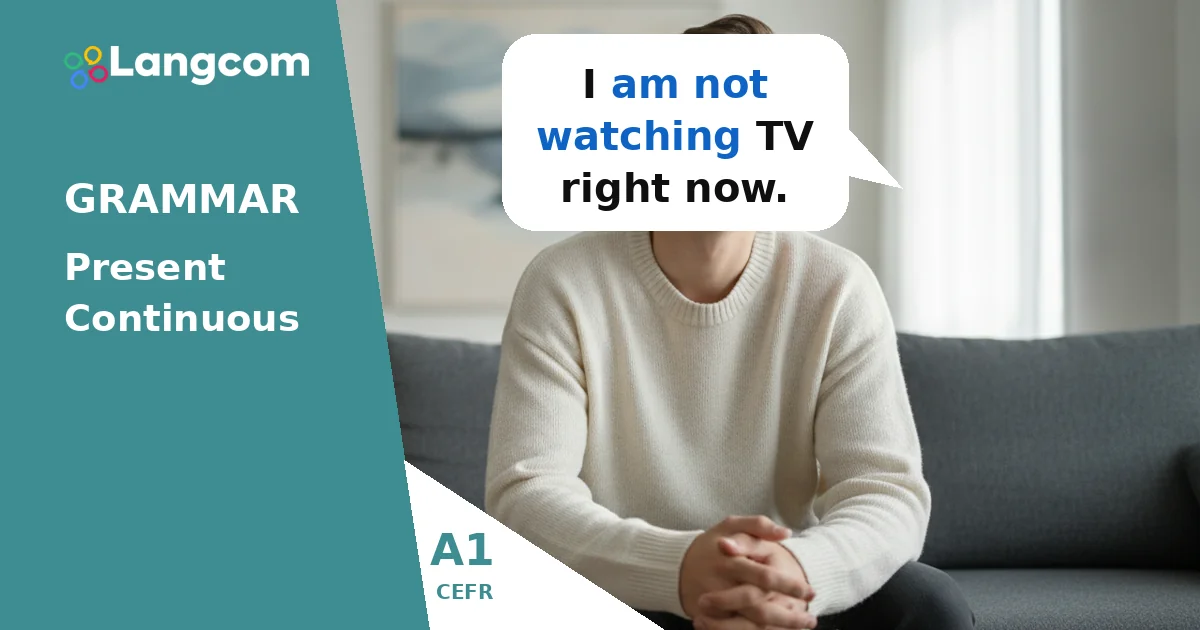
- I am not watching TV right now.
- Are you listening to music?
- No, she isn’t working today.
- What are they eating for lunch?
- Is it raining outside? Yes, it is.
- We aren’t going to the cinema this evening.
Practice
💬 Benötigen Sie eine individuelle Beratung?
Als autorisiertes Cambridge-Vorbereitungszentrum können wir Ihnen helfen, den richtigen Kurs und die passende Zertifizierung zu finden. Chatten Sie noch heute mit unseren Beratern.
Chatten Sie mit einem Berater auf WhatsAppCommon mistakes for Spanish speakers
Spanish speakers sometimes make specific mistakes when using the Present Continuous:
- Missing the verb ‘to be’: In Spanish, you might say ‘Yo no trabajando’ (I not working). In English, you must always include am, is, oder are.
- Incorrect: He not sleeping.
- Correct: He is not sleeping.
- Using ‘do/does’ for questions/negatives: In Spanish, ‘no’ or ‘¿…?’ works differently. In English, do/does is for Simple Present, not Present Continuous.
- Incorrect: Do you working?
- Correct: Are you working?
- Incorrect: I don’t working.
- Correct: I am not working.
- Forgetting the ‘-ing’ form: The main verb must always end in -ing for the continuous tense.
- Incorrect: We are play.
- Correct: We are playing.
Häufig gestellte Fragen
When do I use ‘am’, ‘is’, or ‘are’ in Present Continuous questions?
You use am with I (Am I…?). You use is with he, she, it, and singular nouns (Is he…? Is she…? Is the dog…?). You use are with you, we, they, and plural nouns (Are you…? Are we…? Are the students…?).
Can I use contractions in negative Present Continuous sentences?
Yes, absolutely! Contractions like isn’t (for is not) and aren’t (for are not) are very common in everyday spoken English and informal writing. For I am not, we usually say I’m not.
How can practicing Present Continuous questions help me in speaking tasks?
Practicing Present Continuous questions helps you ask about current activities and respond to questions about what you or others are doing. This is very useful for conversations, interviews, or any speaking task where you need to describe ongoing actions in real-time. For example, you might be asked, What are you doing in your free time these days?


0 Kommentare