

Why Use More Precise Verbs of Thought?
Using a wider range of verbs helps you express yourself more accurately in English. Think und know are general verbs, but they don’t always show the specific way you are thinking or knowing.
More precise verbs add detail and nuance to your sentences. They tell the listener or reader how you arrived at an idea or what kind of knowledge you have.
✍️ Not sure which level you are?
Take our free placement test and get personalized feedback from certified Cambridge examiners.
Machen Sie unseren KOSTENLOSEN EinstufungstestExpressing Beliefs and Certainty
These verbs describe how you form opinions or what you believe to be true.
- Assume: To believe something is true without definite proof, often based on little information. You take it for granted.
- Come to the conclusion: To decide something after thinking about it carefully or considering all the facts. It’s a result of a thought process.
- Doubt: To feel uncertain about something or to believe that something is probably not true. You have reservations.
Expressing Awareness and Understanding
These verbs relate to becoming conscious of facts or ensuring information is correct.
- Realise: To understand or become aware of a fact or situation, often suddenly. It’s a moment of insight.
- Be aware: To know about something, especially a situation or fact. It means having knowledge or information.
- Make sure: To take action so that something definitely happens or is true. You check or confirm something.
- Not have any idea / Have no idea: To not know something at all. It expresses complete lack of knowledge.
Expressing Uncertainty and Estimation
These verbs are used when you are unsure, questioning, or making an educated guess.
- Wonder: To ask yourself questions about something or to express a desire to know. You are curious.
- Estimate: To guess the size, amount, or value of something, often without exact calculation but based on some information.
Beispiele
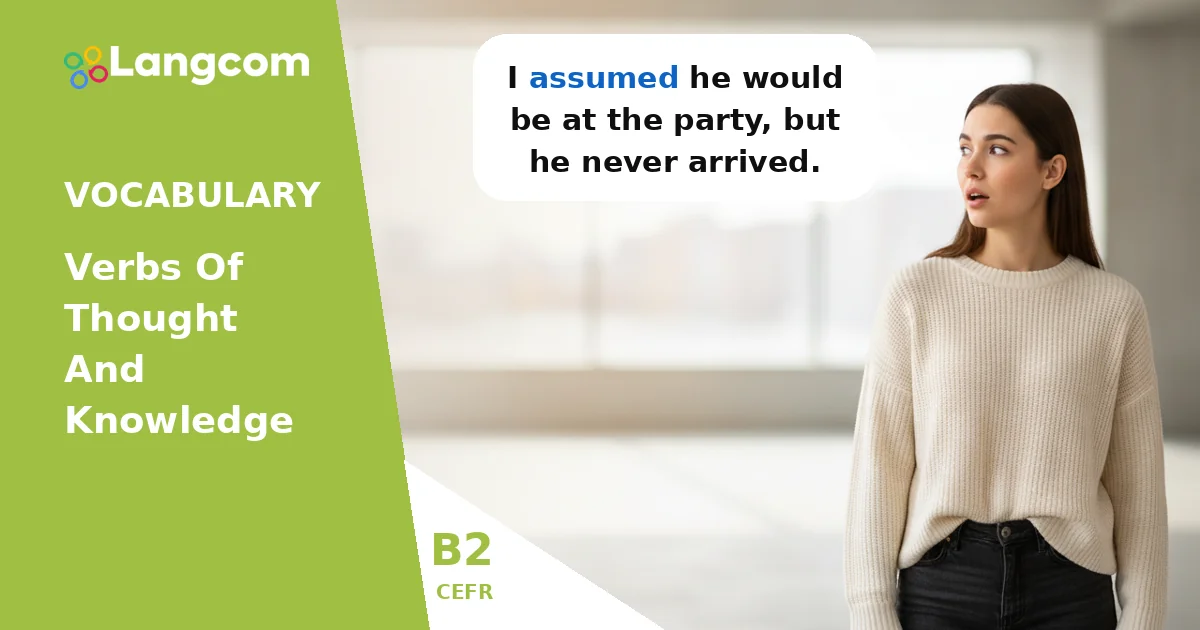
- I assumed he would be at the party, but he never arrived.
- After reviewing all the evidence, we came to the conclusion that she was innocent.
- I doubt that the project will be finished on time.
- She suddenly realised she had left her keys at home.
- Are you aware of the new company policy?
- Please make sure all the windows are closed before you leave.
- I had no idea who those people were.
- I wonder why he decided to change his mind.
- The police estimated the crowd size to be around 10,000 people.
Übung
Ready to earn your certificate?
Langcom prepares students for Cambridge, IELTS, TOEFL, DELE, SIELE and Michigan exams.
Get started with LangcomHäufige Fehler bei Spanischsprechern
Spanish speakers sometimes overuse think when a more specific verb is needed. For example, directly translating ‘pensar’ can lead to:
-
Incorrect: I thought she was famous in her country.
Correct: I assumed she was famous in her country. (If you believed it without proof)
-
Incorrect: I didn’t think who they were.
Correct: I had no idea who they were. (For complete lack of knowledge)
Another common error is confusing realise (darse cuenta) with achieve oder perform (realizar). Remember, realise means to become aware or understand, not to accomplish something.
Häufig gestellte Fragen
What is the difference between ‘think’ and ‘assume’?
Think is a general verb for having an idea or opinion. Assume means to believe something without proof, often based on a guess or incomplete information. You can think about something carefully, but you assume when you take something for granted.
When should I use ‘realise’ instead of ‘know’?
Know means to have information or understanding. Realise means to suddenly understand or become aware of a fact or situation that you didn’t know before. It implies a moment of discovery or insight.
Are these verbs important for B2 level English?
Yes, mastering these verbs is crucial for B2 level. They allow you to express complex ideas and subtle differences in meaning, which is expected at an intermediate-high to advanced level. Using them shows a richer vocabulary and better command of English nuance.
Can I use ‘wonder’ to ask a direct question?
No, wonder is used to express curiosity or to ask yourself a question, not to ask someone else directly. For example, I wonder if it will rain tomorrow is a thought, not a direct question to another person.


0 Kommentare